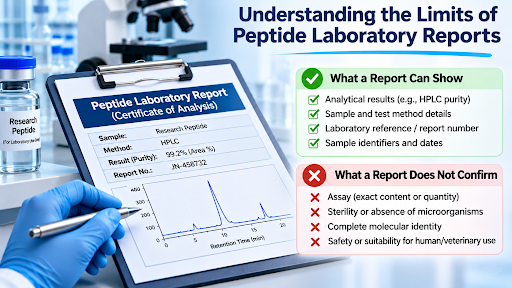
Laboratory reports can provide useful analytical information about research samples, but understanding what they actually confirm is just as important as reading the reported results. A Certificate of Analysis (COA) may contain sample identifiers, analytical methods, chromatograms and reported measurements. However, these details should not be interpreted as proof of every characteristic associated with a product.
For research professionals, the key is to understand the scope of each test, the sample that was examined and the limitations of the analytical method used.
What Does a Peptide Laboratory Report Actually Confirm?
A laboratory report documents the findings of specific tests performed on an identified sample. Its value depends on the laboratory, analytical method, sample identification and information included in the report.
A report should be interpreted within its stated scope. If a laboratory tested one identified sample, its findings apply to that sample under the conditions of the reported analysis. They do not automatically establish the characteristics of every batch, strength or format associated with the same product name.
This distinction is particularly important when reviewing online laboratory documentation. Some product associations may be mapped by suppliers across different strengths or formats. Such mapping is not independent laboratory confirmation that every listed variation was tested.
A report also does not necessarily confirm the identity, concentration, sterility, stability or safety of a material unless appropriate tests were performed and documented for those specific characteristics.
Understanding HPLC Purity Results
High-performance liquid chromatography (HPLC) is an analytical technique used to separate and evaluate components in a sample. In peptide laboratory documentation, HPLC results may be presented as a percentage associated with chromatographic peak areas.
However, an HPLC area-percentage result should not automatically be interpreted as weight-based purity, assay or the exact quantity of the target substance in a sample.
The meaning of a reported percentage depends on the analytical method, detector response, sample preparation, chromatographic conditions, peak integration and the suitability of the method for its intended purpose.
The ICH Q2(R2) guideline on Validation of Analytical Procedures, published through the European Medicines Agency, explains important analytical validation characteristics, including accuracy, precision, specificity and the reportable range. The US Food and Drug Administration’s Q2(R2) guidance also provides a framework for understanding analytical procedure validation.
These principles matter because a numerical result is meaningful only in the context of the method used to produce it.
HPLC Purity Is Not the Same as Assay
HPLC purity and assay are related analytical concepts, but they are not interchangeable.
An HPLC purity result expressed as area percentage generally describes the relative distribution of detected chromatographic peak areas included in the calculation. An assay, by contrast, is intended to quantify the amount or content of a specified substance using an appropriate analytical procedure and reference standard.
The two measurements may require different analytical approaches, calculations and validation evidence. A high area-percentage result alone does not establish the exact amount of the target substance in a sample.
The ICH Q2(R2) guidance distinguishes analytical procedures according to their intended purposes, including assay, purity, impurities and identity testing. Therefore, readers should check which test was actually performed instead of treating every percentage in a report as the same measurement.
What HPLC Results Do Not Establish
An HPLC purity result does not, by itself, establish:
- Complete molecular identity.
- Exact content or assay of the target substance.
- Sterility or absence of microorganisms.
- Endotoxin levels.
- Stability under storage or transport conditions.
- Suitability for human or veterinary use.
- Safety or effectiveness in any biological application.
These characteristics require appropriate testing and supporting evidence. A report that documents one analytical procedure should not be treated as confirmation of tests that were not performed.
For this reason, readers should review the complete report rather than relying only on a headline purity percentage or a summary displayed on a product page.
Why Sample Identification and Traceability Matter
The sample identifier is an essential part of laboratory documentation. It helps connect the reported findings with the material submitted for analysis.
When reviewing a report, check the sample name or identifier, laboratory reference, report date, analytical method and any available batch information. These details help establish which sample the laboratory examined.
It is also important to distinguish a tested sample from a current shipping lot. A published report does not automatically confirm that a product being supplied today comes from the same batch or has identical characteristics.
Where a product page associates a report with multiple strengths or formats, readers should look for clear evidence showing which specific sample was tested. Supplier-provided mapping should not be presented as independent laboratory confirmation.
Reviewing Laboratory Reports Carefully
A careful review should focus on the actual evidence contained in the document.
Start by identifying the issuing laboratory and checking whether the report can be authenticated through the laboratory’s available verification process. Then review the sample details and confirm that the report describes the material being referenced.
Next, identify the analytical method and understand what it was designed to measure. Read the results alongside the method description and any stated limitations. If the report contains an HPLC percentage, establish whether it is an area-percentage result or another clearly defined measurement.
Finally, avoid drawing conclusions beyond the tests documented. Missing information should be treated as unknown rather than assumed to be satisfactory.
The Role of Remy Research in Laboratory Documentation
Remy Research provides a research-focused resource for understanding peptide laboratory documentation and analytical information. Its peptide lab reports resource can help readers review published laboratory records and understand the information associated with identified samples.
As with any published analytical documentation, each report should be interpreted according to its own sample details, methods and stated scope. A report associated with a particular sample should not be treated as independent confirmation of other batches, strengths or formats unless those materials have also been appropriately tested.
Final Considerations
Peptide laboratory reports are most useful when their findings are interpreted carefully and within the limits of the analytical methods used. HPLC area percentage, assay, identity testing and sterility testing address different analytical questions and should not be treated as interchangeable.
Readers should verify the issuing laboratory, review sample identifiers, understand the method and avoid extending a result beyond the sample actually tested. This evidence-based approach helps prevent unsupported conclusions and promotes more accurate interpretation of research documentation.
Research-use-only notice: The information in this article is provided strictly for in-vitro laboratory research and educational purposes. It is not intended for human or veterinary use, diagnosis, treatment, prevention or administration.