Water technology plays an important role in the UAE because water management is closely connected with public health, urban development, industry, agriculture, hospitality, and long-term sustainability. In a country with a naturally arid climate, technologies for producing, treating, purifying, monitoring, transporting, and efficiently using water are essential to modern infrastructure.
The UAE has developed sophisticated water infrastructure that combines desalination, treatment, distribution, reuse, monitoring, and conservation. Alongside large-scale infrastructure, a growing market of specialist companies provides filtration systems, industrial water treatment, engineering services, purification technologies, pumps, membranes, automation, and monitoring solutions.
Understanding the water technology sector is useful for businesses, property owners, engineers, facility managers, and anyone researching how the UAE manages one of its most important resources.
What Is Water Technology?
Water technology refers to the equipment, systems, processes, and digital solutions used to manage water throughout its lifecycle. It can include technologies for water production, desalination, purification, filtration, treatment, storage, distribution, wastewater management, and reuse.
The sector combines several technical disciplines. Chemical engineering, mechanical engineering, electrical systems, environmental science, automation, materials science, data analytics, and software can all contribute to modern water infrastructure.
At a household level, water technology may involve filtration systems, purification units, pumps, or water-quality monitoring. At an industrial or municipal scale, it can involve large treatment plants, desalination systems, pipelines, sensors, control systems, and sophisticated water-management infrastructure.
Why Water Technology Is Important in the UAE
The UAE’s climate makes efficient water management particularly important. Natural freshwater resources are limited, while demand comes from residential communities, commercial buildings, agriculture, tourism, manufacturing, and public infrastructure.
Technology helps address these challenges by enabling water to be produced from alternative sources, treated to required standards, monitored throughout distribution networks, and reused where appropriate.
Water technology is therefore not limited to one industry. It supports many of the systems that allow modern cities and businesses to operate reliably.
Desalination Technology in the UAE
Desalination is one of the most important water-production technologies in the UAE. The process removes salts and other dissolved substances from seawater or other saline water to produce freshwater suitable for defined uses.
Two major desalination approaches are thermal processes and membrane-based processes. Thermal desalination uses heat to separate freshwater from saline water, while reverse osmosis uses membranes and pressure to remove dissolved salts.
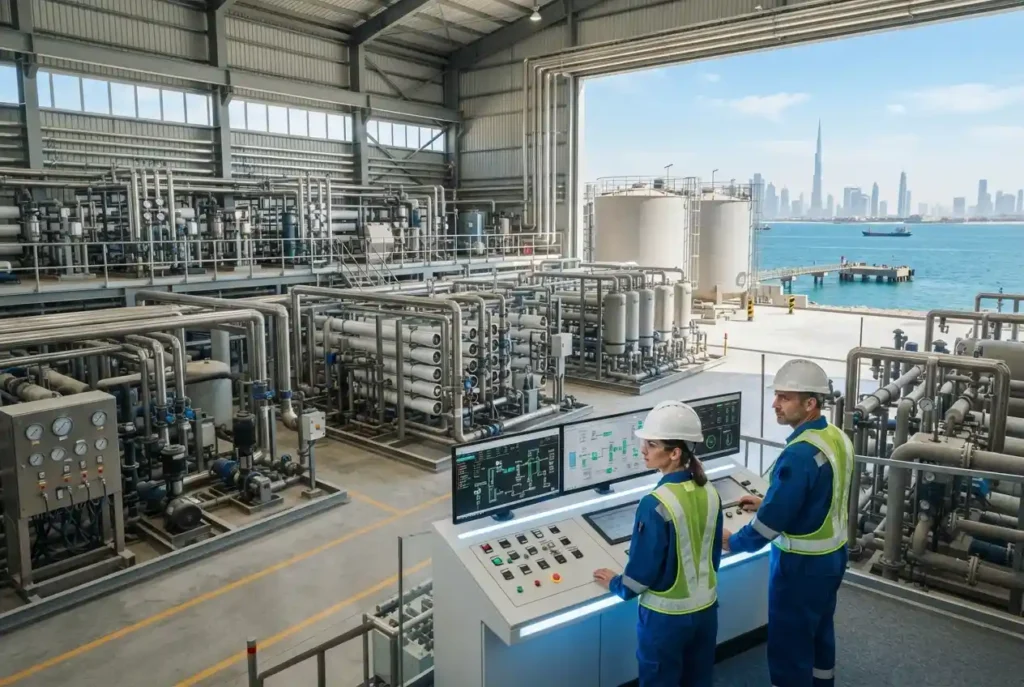
Modern facilities can combine advanced membranes, energy-management systems, monitoring equipment, chemical treatment, and automated controls to improve operational performance.
Reverse Osmosis
Reverse osmosis is widely used in water treatment and desalination. Water is pushed through a specialised membrane under pressure, allowing water molecules to pass while retaining many dissolved salts and contaminants.
Membrane performance depends on factors such as feed-water quality, pressure, temperature, pretreatment, membrane condition, and operating procedures. Proper maintenance is therefore important for consistent performance.
Thermal Desalination
Thermal desalination uses heat and evaporation processes to separate freshwater from salts. While membrane technologies have become increasingly important, thermal processes remain part of the history and infrastructure of desalination in the Gulf region.
The choice of technology depends on factors such as energy availability, plant design, water quality, scale, and operational requirements.
Water Purification Technology
Purification is another major part of the water technology sector. Purification systems can remove physical particles, dissolved substances, microorganisms, odours, and other unwanted components depending on the treatment design.
Different applications require different treatment levels. Drinking-water systems, industrial process water, irrigation water, and wastewater reuse may each have different quality requirements.
Filtration
Filtration removes particles and other materials from water using physical or chemical processes. Common technologies include sand filtration, cartridge filters, multimedia filters, and membrane filtration.
The correct filter depends on the contaminants being targeted and the intended use of the treated water.
Ultrafiltration
Ultrafiltration uses membranes with very small pores to separate suspended solids, microorganisms, and other substances from water. It can be used as part of a larger treatment system or as a pretreatment stage for other technologies.
Ultraviolet Treatment
Ultraviolet systems can be used to inactivate microorganisms by exposing water to UV light. These systems are sometimes incorporated into drinking-water, commercial, and industrial treatment applications.
UV treatment is generally one component of a broader treatment strategy rather than a universal solution for every water-quality issue.
Emirates Water Technology and Local Industry
Emirates Water Technology is among the types of specialist businesses operating within the UAE water sector. Companies working under similar names and descriptions can provide water treatment, filtration, engineering, or related technical services.
Because water companies can operate in very different segments, businesses should verify the exact service portfolio of a provider before selecting it. A residential purification supplier may have completely different capabilities from an industrial water-treatment engineering company.
When comparing providers, it is useful to examine project experience, treatment technologies, equipment brands, technical support, maintenance capabilities, and compliance with applicable UAE requirements.
Pure Water Technology Solutions
Pure water technology generally refers to processes designed to produce water with controlled quality characteristics. Depending on the application, this can involve combinations of filtration, reverse osmosis, deionisation, ultraviolet treatment, distillation, or other processes.
High-purity water is particularly important in industries where water quality can directly affect production. Laboratories, pharmaceuticals, electronics, food processing, healthcare, and certain manufacturing operations may have strict water-quality requirements.
Industrial Water Purification
Industrial facilities may need water for boilers, cooling systems, production processes, cleaning, or other operations. Treatment systems can be designed according to the source-water characteristics and the requirements of the industrial process.
In these environments, water treatment is not simply about producing clean water. It can also involve preventing scaling, corrosion, contamination, and equipment damage.
ARJ Water Technology and Specialist Providers
ARJ Water Technology is another name that may appear when researching specialist water-treatment businesses in the UAE. As with any technology provider, businesses should evaluate the exact products and services offered rather than relying only on a company name or general category.
Water projects can involve significant technical and operational considerations. A provider’s experience with the relevant type of water source, treatment process, flow rate, application, and maintenance requirements can make a substantial difference to project suitability.
Water Engineering Technologies FZC
Water Engineering Technologies FZC represents the engineering side of the water technology market. Water engineering companies can work on system design, treatment equipment, pumps, piping, controls, installation, commissioning, and maintenance.
Engineering expertise becomes particularly important for industrial and commercial projects because the treatment system must work within a larger physical and operational environment.
Engineers may need to consider hydraulic requirements, electrical loads, chemical dosing, equipment compatibility, automation, maintenance access, wastewater disposal, and future expansion.
Smart Water Management
Water technology is increasingly becoming connected with digital systems. Smart water management uses sensors, meters, automation, analytics, and communication networks to collect information about water systems.
Digital monitoring can help operators identify unusual consumption patterns, detect potential leaks, monitor equipment performance, and understand how water is being used across a facility.
Water Monitoring Sensors
Sensors can measure variables such as flow, pressure, temperature, conductivity, pH, turbidity, and other water-quality indicators depending on the application.
Continuous monitoring can provide a more detailed picture than occasional manual testing, although sensor calibration and maintenance remain important.
Leak Detection
Water losses can occur through damaged pipes, faulty equipment, leaking fixtures, or infrastructure problems. Smart meters and monitoring systems can help identify unusual changes in consumption or flow.
Early detection can reduce unnecessary water loss and potentially prevent more serious infrastructure damage.
Automated Treatment Systems
Automation allows treatment facilities to control pumps, valves, dosing systems, filters, and other equipment according to programmed conditions. Operators can also monitor system performance through central control platforms.
Automation does not eliminate the need for human oversight. Skilled operators remain important for maintenance, troubleshooting, system optimisation, and responding to unexpected conditions.
Wastewater Treatment and Water Reuse
Water technology also covers wastewater treatment. Instead of treating used water solely as waste, treatment systems can process it to a quality suitable for specific forms of reuse where regulations and infrastructure allow.
Reuse can support applications such as irrigation, landscaping, cooling, industrial processes, or other non-potable uses. The appropriate treatment level depends on the intended application and applicable standards.
Water reuse can contribute to resource efficiency by reducing demand for newly produced freshwater for uses that do not require drinking-water quality.
Water Technology in Buildings
Commercial buildings, hotels, residential developments, hospitals, schools, and industrial facilities all require water systems. Technology can help manage consumption, treatment, storage, pumping, and quality.
Building managers can use smart meters, pressure monitoring, automated controls, efficient fixtures, water treatment equipment, and leak detection systems to improve water management.
These solutions are increasingly connected with the broader smart-building movement. Businesses interested in connected building systems can also explore our guide to smart technology in UAE.
How Businesses Can Choose a Water Technology Provider
Selecting a water technology company requires a clear understanding of the project’s technical requirements.
Identify the Water Source
The starting point is understanding where the water comes from. Seawater, municipal water, groundwater, industrial process water, and wastewater can have very different treatment requirements.
Define the Intended Use
Water intended for drinking, irrigation, cooling, manufacturing, laboratory use, or other applications may require different treatment processes. The intended use should therefore be defined before equipment is selected.
Request Water Testing
Water analysis can help identify the contaminants and characteristics that a treatment system needs to address. Equipment selection without understanding the source-water quality can lead to inefficient or inappropriate system design.
Consider Maintenance
Filters, membranes, pumps, sensors, dosing systems, and other components require maintenance. Businesses should understand replacement schedules, service requirements, consumables, and ongoing operating costs.
Evaluate Total Cost
The purchase price of equipment is only one part of the overall cost. Energy consumption, chemicals, replacement filters, membranes, labour, maintenance, wastewater management, and downtime can all affect long-term operating expenses.
Water Technology and Sustainability
Water technology is closely connected with sustainability because efficient water management can help conserve resources. Technologies that reduce losses, enable reuse, improve treatment efficiency, or provide better consumption data can support more responsible water management.
The sustainability benefits of a particular system depend on how it is designed and operated. For example, desalination and treatment processes require energy, so improving energy efficiency and integrating appropriate energy sources can be important parts of overall system planning.
Businesses researching this connection can explore our broader coverage of technology and sustainability in the UAE.
The Future of Water Technology in the UAE
Future water systems are likely to become increasingly automated, data-driven, and efficient. Artificial intelligence, predictive analytics, advanced sensors, improved membranes, robotics, and digital twins could support better monitoring and optimisation of water infrastructure.
Predictive maintenance could help operators identify equipment problems before failures occur. Advanced analytics could also help identify consumption patterns and optimise treatment operations.
At the same time, physical engineering will remain essential. Digital tools cannot replace the need for reliable pumps, pipes, membranes, treatment equipment, storage systems, and properly designed infrastructure.
The Final Word
Water technology is a critical part of the UAE’s modern infrastructure. From desalination and purification to wastewater treatment, smart monitoring, engineering, and water reuse, technology helps businesses and communities manage water in a challenging environmental context.
For businesses selecting a water technology provider, the right solution depends on the water source, intended application, required quality, flow capacity, regulatory requirements, energy use, and long-term maintenance needs. Comparing providers based on these factors can lead to more effective and sustainable decisions.
As the UAE continues developing its cities, industries, and sustainability initiatives, water technology will remain an important area of engineering and innovation.