
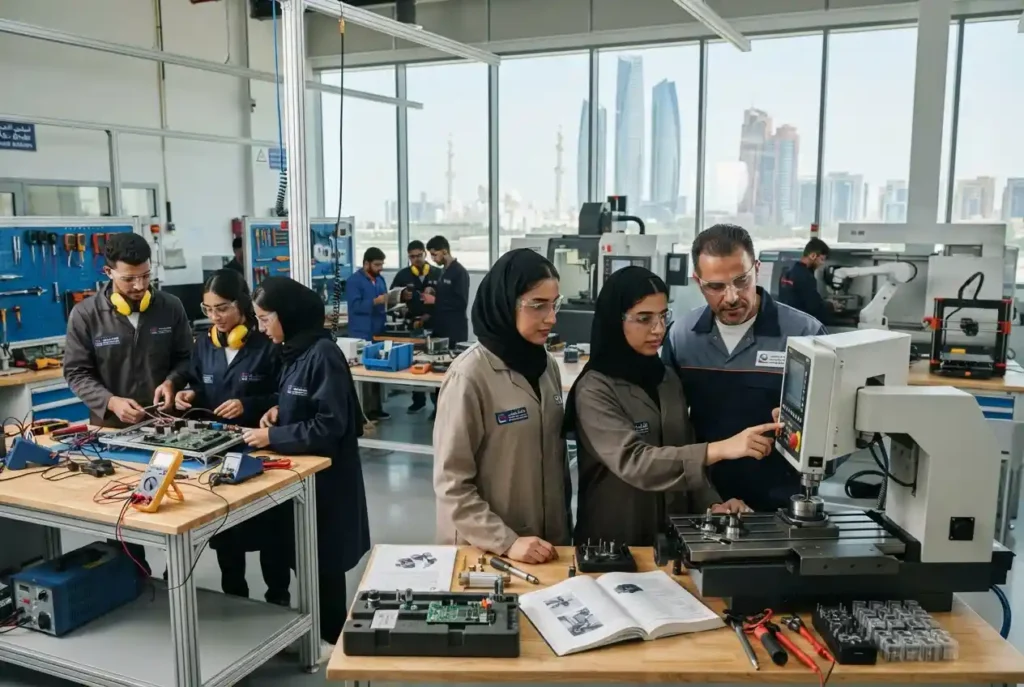
Vocational education provides practical learning pathways for people who want to develop occupation-specific knowledge and skills. Instead of focusing primarily on academic theory, vocational programmes often combine classroom learning with practical activities, technical instruction, workplace preparation, and hands-on experience.
In the UAE, vocational education can be relevant to students, young adults, working professionals, and people considering a career change. Technical skills are needed across many industries, including engineering, construction, hospitality, information technology, healthcare support, logistics, manufacturing, automotive services, and other technical fields.
Vocational learning can also complement broader adult education by providing practical opportunities for learners who want to update their skills or move into a new occupation.
What Is Vocational Education?
Vocational education is education and training designed to prepare learners for specific occupations or groups of related occupations. Programmes may focus on technical knowledge, practical skills, workplace procedures, safety, equipment, technology, or industry standards.
Vocational programmes can range from introductory certificates to advanced technical qualifications. The structure depends on the field, institution, qualification level, and intended career pathway.
Unlike the assumption that vocational education is an alternative only for students who do not want academic study, practical education can complement academic learning. Many modern occupations require a combination of theoretical understanding, technical competence, communication, and problem-solving.
Why Vocational Education Matters in the UAE
The UAE economy includes industries that depend on technically skilled professionals. Construction, transportation, hospitality, engineering, technology, energy, maintenance, healthcare, and other sectors require workers who can apply knowledge in practical settings.
Vocational education can help connect learning with workplace requirements. Students can develop skills that are directly relevant to occupational tasks while also learning about safety, communication, teamwork, and professional responsibility.
For employers, a workforce with appropriate technical capabilities can support productivity and operational quality. For learners, practical qualifications can provide pathways into careers that require specialized skills.
Vocational Education and Technical Education
Vocational education and technical education overlap significantly, although the terms can be used differently depending on the educational system.
Technical education often emphasizes technical knowledge, systems, tools, equipment, and applied science. Vocational education can have a broader occupational focus and may include practical training for specific professions.
Both approaches can help learners develop skills that are applicable outside a purely academic classroom.
Those interested in this area can explore technical education to understand how technical learning contributes to workforce preparation.
Who Can Benefit From Vocational Education?
Vocational education can serve learners at different stages.
- Secondary school students exploring career pathways
- Young adults entering the workforce
- Professionals developing technical skills
- Workers seeking additional qualifications
- People changing careers
- Adults returning to education
- Employees preparing for new workplace responsibilities
The appropriate programme depends on previous education, experience, career goals, and the entry requirements of the training provider.
Common Areas of Vocational Training
Vocational education covers many occupational areas. Some programmes are closely linked to traditional trades, while others focus on modern technical and digital occupations.
Engineering and Technical Trades
Engineering-related vocational programmes can cover areas such as electrical systems, mechanical maintenance, electronics, fabrication, machinery, and other technical disciplines.
Students often need both theoretical understanding and practical experience because technical work involves applying principles to real equipment and situations.
Information Technology
Technology-focused vocational education can cover computer support, networking, software applications, cybersecurity fundamentals, digital systems, and other technical areas.
As technology changes quickly, professionals in this field may need continuing training throughout their careers.
Automotive Skills
Automotive training can prepare learners for roles involving vehicle maintenance, diagnostics, electrical systems, mechanical components, and workshop operations.
Practical experience is particularly important because technicians need to work confidently with tools, equipment, diagnostic systems, and safety procedures.
Hospitality and Culinary Skills
Vocational programmes in hospitality can include food preparation, kitchen operations, hotel services, customer service, housekeeping, front-office operations, and event-related skills.
These programmes often combine technical skills with communication and customer-service training.
Practical Learning in Vocational Education
Hands-on learning is one of the defining characteristics of vocational education. Students may work with equipment, tools, simulations, software, models, or practical assignments depending on the programme.
Practical learning gives students opportunities to apply concepts rather than simply read about them. It can also reveal areas where additional practice is required.
Instructors can observe students performing tasks and provide immediate feedback, helping learners develop accuracy and confidence.
Skill Development and Employability
Vocational education is closely connected with skill development because programmes are often designed around practical occupational competencies.
However, employability requires more than technical ability. Employers may also expect communication, teamwork, reliability, problem-solving, time management, safety awareness, and professional conduct.
Strong vocational programmes therefore combine technical training with transferable workplace skills.
This broader approach to skill development can help learners become more adaptable as job responsibilities evolve.
Vocational Education and Industry Needs
Effective vocational education should maintain a connection with real workplace requirements. Training providers can support this connection through industry partnerships, employer input, practical projects, workplace visits, internships, apprenticeships, or other forms of work-based learning where appropriate.
Industry involvement can help educators understand which technical skills employers currently need and where graduates may require additional preparation.
However, training should not focus only on immediate job vacancies. Students also need foundational skills that allow them to adapt as technology and occupational requirements change.
Role of Teachers and Trainers
Vocational instructors need strong knowledge of their subject as well as the ability to demonstrate practical tasks clearly. Students may need step-by-step guidance when learning unfamiliar equipment or procedures.
Trainers should also explain why a procedure matters rather than requiring learners to memorize instructions without understanding the underlying principles.
Assessment can include practical demonstrations, projects, written tasks, observations, simulations, and other methods appropriate to the occupation.
Vocational Education and Curriculum Development
Curriculum development is important in vocational education because programmes need to balance theoretical knowledge, practical competencies, safety requirements, and workplace expectations.
A strong vocational curriculum should define what learners need to know and what they need to be able to do. Practical competencies should be introduced progressively so that students develop foundational skills before attempting more complex tasks.
Educators interested in academic planning can explore curriculum development for a broader understanding of how learning objectives, content, assessment, and progression are connected.
Vocational Education for Young Learners
Career-oriented learning can help young people understand that there are multiple pathways into professional life. Not every student needs to follow exactly the same academic route.
Vocational programmes can provide students with opportunities to discover practical interests and develop technical skills while continuing their broader education.
Career guidance is important at this stage. Students should understand what a qualification involves, which occupations it can lead toward, and what further education may be available later.
Vocational Education for Adults
Adults may choose vocational training when they want to change careers, develop new skills, or improve their prospects in an existing occupation.
Flexible delivery can be particularly useful for working adults. Evening programmes, weekend training, blended learning, modular courses, and short professional programmes can make education more accessible.
Before enrolling, adult learners should consider whether the qualification is recognized and whether the practical skills taught are relevant to their intended occupation.
Technology in Vocational Training
Technology is increasingly influencing vocational education. Modern training may involve digital simulations, computer-controlled equipment, diagnostic software, virtual learning environments, online assessments, and other digital tools.
These technologies can supplement practical training, particularly when access to expensive equipment is limited. However, simulation should complement rather than automatically replace real-world practical experience when physical competence is essential to the occupation.
Safety Training and Vocational Education
Safety is an essential part of many technical occupations. Students need to understand how to identify hazards, use equipment correctly, follow procedures, and respond appropriately to workplace risks.
Safety training should be integrated into practical education rather than treated as a separate topic that students study only before entering a workshop.
Instructors should model safe behavior and ensure that students understand the reasons behind safety procedures.
Assessment in Vocational Education
Vocational assessment often needs to measure practical competence as well as theoretical understanding.
A written examination may demonstrate that a learner understands a technical concept, but practical assessment can show whether they can apply that knowledge correctly.
Depending on the programme, assessment may include:
- Practical demonstrations
- Workplace simulations
- Technical assignments
- Projects
- Written examinations
- Oral questioning
- Observation of workplace tasks
- Portfolio evidence
Assessment methods should align with the competencies that learners are expected to develop.
How to Choose a Vocational Education Programme
Choosing a vocational programme requires more than looking at the course title. Learners should investigate the qualification, curriculum, practical facilities, instructors, duration, entry requirements, assessment, and progression opportunities.
Consider the following questions:
- What occupation or skills does the programme prepare me for?
- Is the qualification recognized by relevant authorities or employers?
- How much practical training is included?
- What equipment and facilities are available?
- Who teaches the programme?
- What are the entry requirements?
- Can the qualification support further study?
- Does the programme fit my career goals?
Comparing these factors can help learners avoid choosing a programme based only on marketing claims.
Vocational Education and Career Progression
Vocational learning does not have to end when a person obtains their first qualification. Professionals can continue developing advanced technical skills, supervisory capabilities, specialist knowledge, or management competencies.
Career progression may involve moving from trainee to technician, senior technician, supervisor, specialist, or manager depending on the occupation.
Experience remains important, but additional training can help professionals prepare for increased responsibilities.
Continuing Education for Technical Professionals
Technical occupations can change as equipment, software, standards, and processes evolve. Professionals therefore need opportunities to refresh their knowledge.
Continuing education can involve manufacturer training, industry workshops, advanced technical courses, professional certifications, or workplace development programmes.
This reflects the broader principle of lifelong learning, where professionals continue developing their capabilities throughout their working lives.
Vocational Education and STEM
Vocational education can connect closely with STEM learning. Technical occupations often require practical applications of science, technology, engineering, and mathematics.
For example, an electrical technician may use mathematical calculations and scientific principles, while an engineering technician may combine technical theory with practical design and testing.
Students interested in interdisciplinary technical learning can explore STEM education to understand how these disciplines contribute to broader educational and career pathways.
Challenges in Vocational Education
One challenge is ensuring that training facilities and equipment remain relevant to industry. Technical education can quickly become outdated if students learn only on old systems or processes.
Another challenge is maintaining strong connections between training providers and employers. Without industry input, programmes may not fully reflect workplace expectations.
There can also be misconceptions about vocational careers. Some people continue to view practical education as less valuable than academic study, even though many technical occupations require significant knowledge, responsibility, and professional competence.
Changing Perceptions of Vocational Careers
Career decisions should be based on interests, abilities, employment opportunities, and long-term goals rather than assumptions about whether one educational pathway is superior to another.
Vocational careers can provide opportunities for people who enjoy practical problem-solving, working with technology, operating equipment, building systems, repairing machinery, creating products, or delivering technical services.
As industries become more technologically advanced, some technical roles require increasingly sophisticated knowledge and digital capabilities.
The Future of Vocational Education in the UAE
Future vocational education will likely need to respond to technological change, automation, digitalization, sustainability, advanced manufacturing, smart infrastructure, and evolving workplace requirements.
Training providers may increasingly combine traditional practical skills with digital tools, data, automation, and technology-based systems.
This makes adaptability an important part of vocational preparation. Students need to learn not only how to perform current tasks but also how to continue learning as their occupation changes.
Final Thoughts on Vocational Education
Vocational education provides practical pathways for learners who want to develop occupation-specific knowledge and technical competence. In the UAE, it can support students, working professionals, and career changers across a wide range of industries.
The strongest vocational programmes combine practical experience with theoretical understanding, safety awareness, communication, problem-solving, and workplace skills. Industry connections can further help ensure that training remains relevant to real occupational requirements.
For learners, choosing the right programme requires careful research. Qualification recognition, practical facilities, curriculum quality, instructor expertise, assessment methods, and career progression should all be considered before making a decision.
Vocational education should ultimately be viewed as one of several valuable routes into professional life. By combining technical preparation with continuous skill development and lifelong learning, vocational learners can build capabilities that remain useful as industries and technologies continue to evolve.