
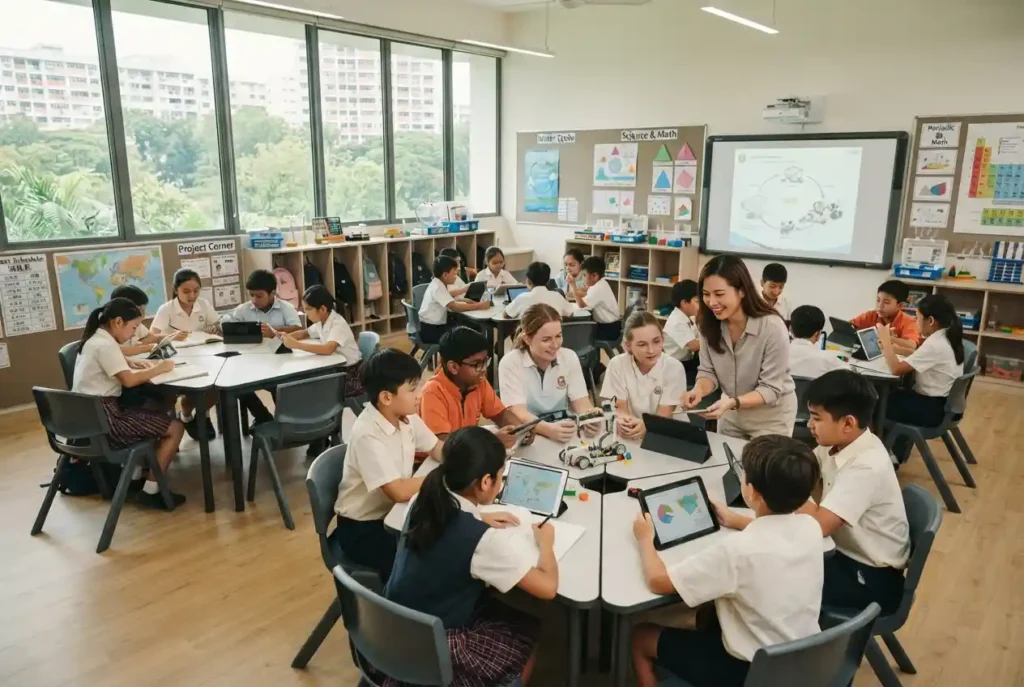
The Singapore education system is widely studied because of its structured approach to learning, strong emphasis on foundational skills, teacher development, bilingual education, and multiple pathways for students with different abilities and interests.
For families researching international education, understanding how education in Singapore is organized can provide useful context when comparing school systems. Singapore combines a centralized education framework with different pathways designed to support students beyond a single academic route.
The system also places emphasis on developing students beyond examination performance. Singapore’s Ministry of Education describes its education goals in terms of developing confident individuals, self-directed learners, active contributors, and responsible citizens.
What Is the Singapore Education System?
The Singapore education system is overseen by the Ministry of Education and includes early childhood education, primary education, secondary education, post-secondary pathways, technical education, and higher education.
One of its defining characteristics is the availability of different educational pathways. Students do not necessarily follow one identical route throughout their schooling. The system is designed to recognize differences in learning needs, abilities, interests, and aspirations.
Singapore’s Ministry of Education states that schools aim to develop students holistically, covering academic foundations as well as physical, aesthetic, moral, social, and emotional development.
How Education in Singapore Is Structured
At a broad level, education in Singapore can be viewed as a progression from early childhood and primary education into secondary and post-secondary pathways. Each stage has a different purpose and set of learning expectations.
Early Childhood Education
Early childhood education provides the foundation for children’s development before formal primary schooling. It supports language development, social interaction, communication, basic numeracy, and other early learning skills.
Singapore has continued developing its early childhood sector, while the Ministry of Education also operates MOE Kindergartens. Recent policy initiatives have included additional attention to language exposure and positive reading habits at the kindergarten and primary levels.
Primary Education
Primary education establishes important foundations in literacy, numeracy, languages, and broader areas of learning. Students also participate in experiences intended to develop social, emotional, physical, and creative capabilities.
One notable characteristic of the system is its bilingual policy. Students generally learn English alongside an official Mother Tongue Language. The Ministry of Education describes bilingualism as a cornerstone of Singapore’s education system because it helps students develop language and cultural competencies in a multicultural society.
Secondary Education
Secondary education builds on the primary foundation while allowing students to develop different academic and practical interests. Students can follow pathways that correspond with their strengths and longer-term educational goals.
Singapore has been moving toward a more flexible approach to secondary education. The Ministry of Education has introduced changes intended to provide students with greater flexibility in subject combinations and learning pathways rather than defining students through a single academic stream.
This reflects a broader principle within the Singapore system: students can have different strengths while still receiving a strong common educational foundation.
The Bilingual Approach in Singapore Schools
Language is an important part of education in Singapore because the country has a multicultural and multilingual population. English serves as the main language of instruction in schools, while students also study a designated Mother Tongue Language.
The bilingual approach has academic and cultural purposes. Students develop communication skills while also maintaining connections with cultural and linguistic traditions.
For international families, this can be an important consideration when researching education in Singapore. A child’s language background, previous schooling, and ability to adapt to the language environment may influence the transition into a Singaporean school.
Why Teachers Are Important in the Singapore Education System
Teachers play a central role in the Singapore education system. The Ministry of Education identifies teachers as a core component of the system and emphasizes rigorous pre-service preparation and continuing professional development.
Teacher education is closely connected with the National Institute of Education, which provides professional preparation and development for educators. Singapore also supports teacher academies, specialist institutes, and professional learning opportunities.
This emphasis matters because curriculum design alone does not determine educational quality. Teachers need the knowledge, classroom skills, subject expertise, and professional support required to turn curriculum goals into meaningful learning experiences.
Beyond Academic Subjects
The Singapore education model does not focus exclusively on classroom examinations. Schools provide co-curricular activities, student leadership opportunities, outdoor learning, community involvement, and applied learning experiences.
The Ministry of Education describes programmes such as Values in Action, co-curricular activities, Applied Learning Programmes, and Learning for Life Programmes as ways for students to apply learning and develop broader competencies.
These activities can help students develop communication, collaboration, leadership, resilience, creativity, and social awareness. They also provide opportunities for students to discover interests that may not be obvious through conventional academic subjects.
Multiple Pathways After Secondary School
One of the strengths of the Singapore education framework is that students have several options after secondary education. These can include junior colleges, polytechnics, the Institute of Technical Education, and other post-secondary routes depending on students’ qualifications and goals.
Academic and technical education are therefore not necessarily viewed as identical routes to the same destination. Students can choose pathways that align with their interests, abilities, and career plans.
The Institute of Technical Education provides technical and vocational education, while polytechnics offer diploma-level programmes in areas connected with professional and technical careers. Universities provide further academic and professional education.
Singapore Education System and Technology
Technology is increasingly becoming part of education in Singapore. Digital learning resources can support classroom instruction, independent learning, collaboration, and access to educational materials.
However, technology is generally most effective when it is connected to sound teaching practices. Digital tools can provide additional ways to explain concepts, practice skills, or access information, but they do not eliminate the importance of teachers and well-designed curriculum.
This combination of traditional and digital learning is increasingly relevant internationally. Schools can also use physical resources such as educational posters alongside digital tools to reinforce key concepts in the classroom.
Assessment and Student Development
Assessment remains an important part of Singapore’s education landscape, but the system has increasingly placed attention on broader student development. The goal is not simply to measure what students can remember but also to support learning progress and identify areas where additional help may be useful.
The Ministry of Education has described assessment as one tool for addressing learning gaps. This suggests that assessment can serve both measurement and learning-support purposes.
For parents, this distinction is useful. A strong education system needs reliable assessment, but students also need opportunities to develop curiosity, confidence, collaboration, creativity, and other capabilities that may not be fully captured by examinations.
Education in Singapore for International Families
Singapore attracts families from different countries, so international parents often research the education system before relocating. The country’s schools include government schools as well as international and private education providers.
Families considering schooling in Singapore should research admissions requirements, school location, curriculum, language expectations, fees, transportation, and the availability of places.
International families should also distinguish between Singapore’s national education system and international schools. International schools may follow curricula from other countries or international organizations and can have different admission procedures and fee structures.
What Makes the Singapore Education System Different?
Several characteristics help explain why the system attracts international attention.
Strong Foundational Learning
Literacy and numeracy are treated as important foundations. Students need these skills before they can successfully engage with more complex academic and practical subjects.
Multiple Learning Pathways
The system recognizes that students have different strengths and aspirations. Different pathways can allow students to progress toward academic, technical, or professional goals.
Teacher Development
Teacher preparation and professional development are emphasized as essential components of education quality. This supports consistency between national education objectives and classroom practice.
Holistic Development
Students are encouraged to develop social, emotional, physical, moral, and creative capabilities alongside academic knowledge.
Bilingual Education
The combination of English and Mother Tongue Language education reflects Singapore’s multicultural environment and gives language learning an important role in the school experience.
Education in Singapore vs Other International Systems
Comparing education systems can be useful, but there is no universal model that works identically in every country. Education reflects national culture, demographics, economic priorities, language, government policy, and social expectations.
For example, education in Costa Rica operates within a different national and cultural context. Costa Rica’s Ministry of Public Education is responsible for developing and consolidating the country’s education system, with an emphasis on quality education, comprehensive development, opportunity, and social equity.
Costa Rica also offers different educational modalities and programmes, including bilingual primary education, indigenous education, technical education, special education, and pathways for young people and adults.
This comparison demonstrates why international education rankings should be interpreted carefully. A system’s structure may be successful partly because it responds to the country’s own circumstances.
What Parents Can Learn From Singapore
Parents do not need to copy an entire national education system to benefit from its ideas. Several principles can be applied more broadly at home or in other school environments.
- Build strong literacy and numeracy foundations.
- Encourage children to develop interests beyond examination subjects.
- Use structured routines while allowing room for curiosity.
- Support bilingual or multilingual learning where appropriate.
- Encourage participation in sports, arts, projects, and community activities.
- Teach children to become increasingly responsible for their own learning.
- Use educational technology as a tool rather than a replacement for good teaching.
Singapore Education System and Lifelong Learning
Singapore’s education philosophy increasingly emphasizes learning as a continuing process rather than something that ends when formal schooling is completed. This approach is particularly relevant as technology changes workplaces and people need to update their skills throughout their careers.
The Ministry of Education’s recent initiatives continue to emphasize lifelong learning, different strengths and needs, and preparation for an increasingly technology-driven future.
This creates a broader definition of educational success. Instead of focusing only on school completion, lifelong learning encourages people to remain curious, adaptable, and willing to acquire new knowledge throughout adulthood.
Lessons for UAE Parents and Educators
For UAE families and educators, studying international systems such as Singapore’s can provide ideas for improving learning environments. The UAE already has a diverse education sector that includes government schools, private schools, international curricula, universities, and specialized education providers.
The most useful lessons may involve strengthening foundational skills, supporting teachers, encouraging multilingual abilities, providing different learning pathways, and giving students opportunities to apply classroom knowledge in practical settings.
International comparisons can also help parents understand that educational quality involves many interconnected factors. Curriculum, teaching, assessment, student wellbeing, family involvement, technology, and extracurricular experiences all contribute to the overall learning environment.
Wrapping Up
The Singapore education system combines structured foundations with multiple pathways and an emphasis on holistic student development. Bilingual education, teacher preparation, applied learning, co-curricular activities, and lifelong learning all form important parts of the broader approach.
For international families, understanding how education in Singapore works can make school comparisons more meaningful. At the same time, comparisons with systems such as Costa Rica show that education should always be considered within its national context.
The most valuable lesson is not that one country has the perfect education model. Instead, Singapore demonstrates how clear educational goals, teacher development, multiple pathways, and continuous policy development can work together to create a coherent learning system.







