
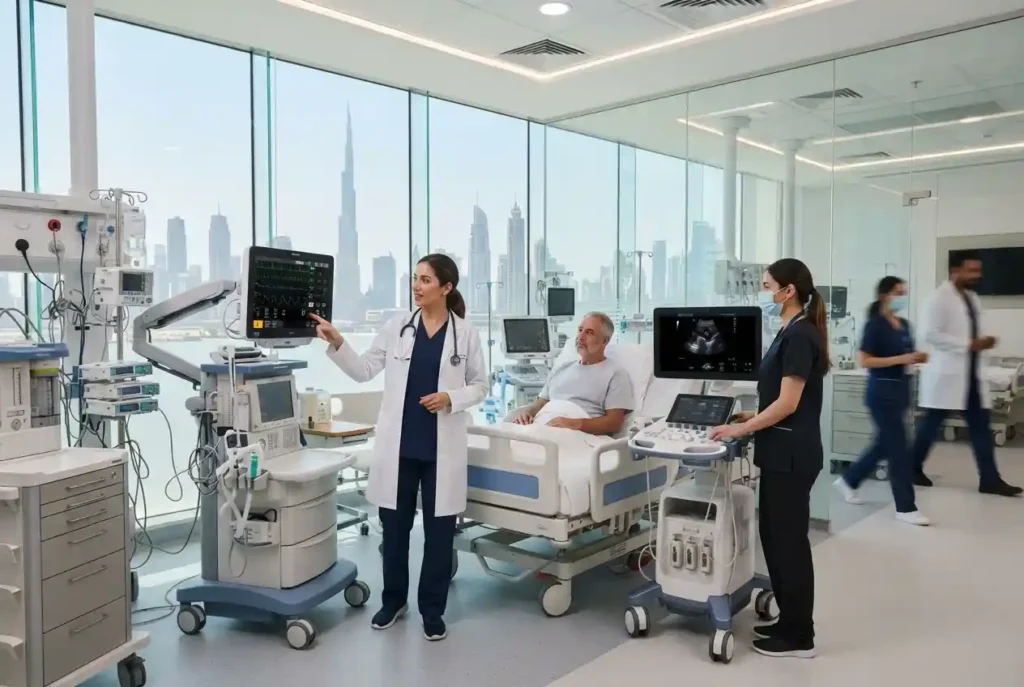
Medical equipment companies play an important role in the UAE’s healthcare ecosystem. Hospitals, specialist clinics, diagnostic centres and other healthcare facilities depend on reliable medical technology for monitoring, diagnosis, treatment and patient care. From imaging systems and patient monitoring equipment to respiratory care and connected health technologies, medical equipment is closely linked to the quality and efficiency of modern healthcare delivery.
For businesses and healthcare professionals researching the sector, Philips Healthcare Middle East & Turkey is one of the names that naturally comes into focus. Other international healthcare technology brands, including OMRON and Baxter, also have relevance to the wider Middle East healthcare market. At the same time, Dubai has developed an ecosystem where medical equipment companies operate alongside hospitals, clinics, pharmacies, pharmaceutical businesses and healthcare service providers.
This guide looks at the role of major medical equipment companies in the UAE, the types of technology they provide, and what businesses should consider when evaluating suppliers and healthcare equipment.
What Do Medical Equipment Companies Do?
Medical equipment companies develop, manufacture, distribute or support technologies used in healthcare environments. Their products can range from relatively simple monitoring devices to sophisticated systems used in hospitals and specialist treatment centres.
Common categories include diagnostic imaging, patient monitoring, respiratory care, cardiovascular equipment, surgical technologies, laboratory systems, home healthcare devices and digital health solutions.
The role of a medical equipment supplier does not necessarily end when a product is delivered. Installation, calibration, maintenance, technical support, user training and replacement parts can all be important parts of the relationship between a healthcare facility and its equipment provider.
Philips Healthcare Middle East & Turkey
Philips Healthcare Middle East & Turkey represents the regional presence of Philips in healthcare technology. Philips is widely associated with medical imaging, patient monitoring, healthcare informatics and other technologies designed to support healthcare professionals and patients.
For hospitals and healthcare organisations, the value of a large medical technology provider is not simply the equipment itself. Healthcare facilities may need systems that can integrate into existing clinical workflows, communicate with other technologies and receive ongoing technical support.
When evaluating a Philips healthcare solution or any comparable medical technology, buyers should therefore look beyond product specifications. Compatibility, service arrangements, training, maintenance requirements, regulatory compliance and total ownership costs can all influence the long-term value of a healthcare system.
Why Philips Healthcare Matters to UAE Healthcare
The UAE healthcare market includes hospitals, specialist clinics, diagnostic facilities and other healthcare operators that require increasingly sophisticated medical technology. Dubai Healthcare City is one of the most prominent healthcare ecosystems in the country and includes clinical facilities as well as businesses connected with healthcare services and medical equipment.
Dubai Healthcare City states that its clinical ecosystem includes pharmacies, medical equipment companies, healthcare recruitment firms, healthcare consulting firms and pharmaceutical companies. This illustrates how equipment providers form part of a broader healthcare business environment rather than operating separately from clinical services.
For readers researching the wider commercial ecosystem, our guide to companies in Dubai Healthcare City provides additional context about businesses operating within this healthcare-focused environment.
OMRON Healthcare Middle East
OMRON Healthcare Middle East is another important name when researching healthcare technology and medical equipment serving the region. OMRON is particularly well known for health monitoring products, including blood pressure monitoring technologies and other devices used in healthcare and home settings.
OMRON Healthcare Europe B.V. states that its healthcare division covers Europe, Russia, the Middle East and Africa and provides service across more than 74 countries through its distribution network. Its official distribution information also lists a United Arab Emirates distributor in Dubai Healthcare City.
This regional distribution model highlights an important aspect of medical equipment supply. International manufacturers often work through regional distributors and local partners to provide products, technical assistance and customer support in different markets.
Baxter Healthcare Dubai
Baxter Healthcare Dubai is another search term associated with the UAE’s medical technology and healthcare supply landscape. Baxter operates internationally across healthcare technologies and solutions, with its activities spanning areas such as medical products, therapies and technologies used by healthcare professionals.
For healthcare organisations, working with a global supplier can provide access to established technologies and specialised product knowledge. However, procurement decisions should still be based on the requirements of the specific facility, including clinical use, compatibility, training, servicing and regulatory considerations.
Dubai’s position as a regional business hub can also make the city relevant for healthcare companies supporting hospitals and medical facilities across the wider Middle East.
Medical Equipment Companies in Dubai Healthcare City
Dubai Healthcare City has developed as a specialised healthcare and wellness ecosystem rather than simply a collection of medical clinics. Its official information identifies medical equipment companies among the types of businesses that can operate within its clinical complex.
The ecosystem is supported by regulatory requirements designed to maintain standards for healthcare facilities and professionals. DHCA’s regulatory information states that medical equipment used within Dubai Healthcare City must be certified, appropriately maintained and kept in proper working condition.
For equipment suppliers and healthcare operators, this creates an environment where product quality, maintenance and compliance are important parts of the medical technology lifecycle.
Bio Med Healthcare Products Pvt Ltd
Bio Med Healthcare Products Pvt Ltd is another term that may appear in searches for medical and healthcare product suppliers. Companies operating in this broad category can serve different parts of the healthcare supply chain, from medical consumables and equipment to specialised products for clinical use.
When researching a particular supplier, businesses should verify the company’s current product portfolio, authorised distribution status, regulatory approvals and service capabilities. Company names can sometimes be similar across different markets, so checking official registration and supplier documentation is particularly important before entering into a procurement agreement.
Fine Healthcare FZC
Fine Healthcare FZC is another name associated with searches for healthcare-related businesses in the UAE and wider Gulf market. Free-zone healthcare businesses can serve different functions, including distribution, trading and regional supply.
For healthcare facilities considering a supplier, the most important question is not simply whether a company operates in the healthcare sector. Buyers should determine whether the supplier is authorised to provide the specific equipment required and whether it can support installation, maintenance, training and after-sales service.
What to Consider When Choosing Medical Equipment Suppliers
Regulatory Compliance
Healthcare equipment is used in environments where patient safety is critical. Buyers should verify that equipment meets applicable UAE requirements and that the supplier can provide the documentation required for procurement and operation.
Technical Support
A sophisticated medical device can become a major operational problem if technical support is unavailable. Before purchasing, healthcare organisations should understand response times, maintenance arrangements, spare-parts availability and escalation procedures.
Training
Some medical technologies require specialised training. Suppliers that provide appropriate user training can help healthcare teams operate equipment correctly and efficiently.
Compatibility
Healthcare facilities often operate multiple systems from different manufacturers. Compatibility with existing equipment, software and clinical workflows should therefore be evaluated before a purchase is approved.
Total Cost of Ownership
The purchase price is only one part of the cost. Installation, maintenance, software updates, consumables, calibration, replacement components and staff training can all affect the total cost of owning medical equipment.
Medical Equipment and the Growth of UAE Healthcare
The UAE’s healthcare sector continues to develop across hospitals, specialist medicine, diagnostics, wellness and medical tourism. This creates demand for technology that can support more specialised and efficient healthcare services.
Dubai Healthcare City is one example of this ecosystem. Its official information describes the free zone as a healthcare and wellness environment with clinical and commercial businesses, while its regulatory arm oversees licensing and healthcare standards.
Medical equipment companies consequently have an important supporting role. They provide the technologies that allow healthcare providers to deliver diagnostics, monitoring, treatment and other clinical services.
This connection also makes medical technology relevant when researching healthcare providers in the UAE. Hospitals and clinics cannot be considered independently from the infrastructure, technology and suppliers that support their operations.
Medical Equipment vs Healthcare Products
Medical equipment and healthcare products overlap, but they are not always the same category. Medical equipment often refers to devices and technologies used for diagnosis, monitoring or treatment, particularly within clinical settings. Healthcare products can include a much broader range of consumer, home-care and everyday health items.
For example, a hospital patient-monitoring system and a home blood-pressure monitor both relate to health monitoring, but their intended users, technical requirements and regulatory environments can be very different.
Understanding this distinction helps healthcare businesses identify appropriate suppliers and prevents buyers from comparing products that serve fundamentally different purposes.
The Importance of After-Sales Service
After-sales support can be just as important as the initial purchase. Medical equipment may require regular maintenance, calibration, software support or replacement components. A healthcare facility that cannot access timely technical assistance may face operational disruptions.
Before signing a supply agreement, organisations should ask about warranty coverage, service contracts, preventive maintenance schedules, emergency support and the availability of trained technicians.
These considerations become even more important for critical equipment used continuously in hospitals or specialist treatment environments.
How the UAE Healthcare Supply Chain Works
The healthcare supply chain involves manufacturers, regional distributors, importers, authorised dealers, healthcare facilities and service providers. An international manufacturer may develop equipment in one market, work with a regional organisation for distribution and rely on local technical partners for installation and servicing.
This structure allows global healthcare technology to reach UAE facilities while giving local healthcare businesses access to specialised products and technical support.
For organisations considering expansion into the healthcare sector, this supply-chain structure also creates opportunities beyond direct clinical care. Distribution, medical equipment servicing, healthcare technology, consulting and specialised support can all contribute to the broader healthcare economy.
In Summary
Medical equipment companies are an essential part of the UAE healthcare ecosystem. Names such as Philips Healthcare Middle East & Turkey, OMRON and Baxter illustrate the international technology providers that can be relevant when researching healthcare equipment in the region, while local and regional suppliers support the practical distribution and servicing of healthcare products.
For businesses operating in Dubai, the healthcare ecosystem surrounding Dubai Healthcare City provides an additional reason to understand how equipment companies, hospitals, clinics, pharmacies and pharmaceutical businesses connect. The official DHCC framework specifically recognises medical equipment companies within its healthcare-oriented business environment and places importance on properly certified and maintained equipment.
Ultimately, choosing medical equipment should involve more than comparing brands. Healthcare organisations should evaluate regulatory compliance, clinical suitability, interoperability, technical support, maintenance and total ownership costs. A reliable supplier relationship can be just as important as the equipment itself when supporting safe and efficient healthcare delivery.