
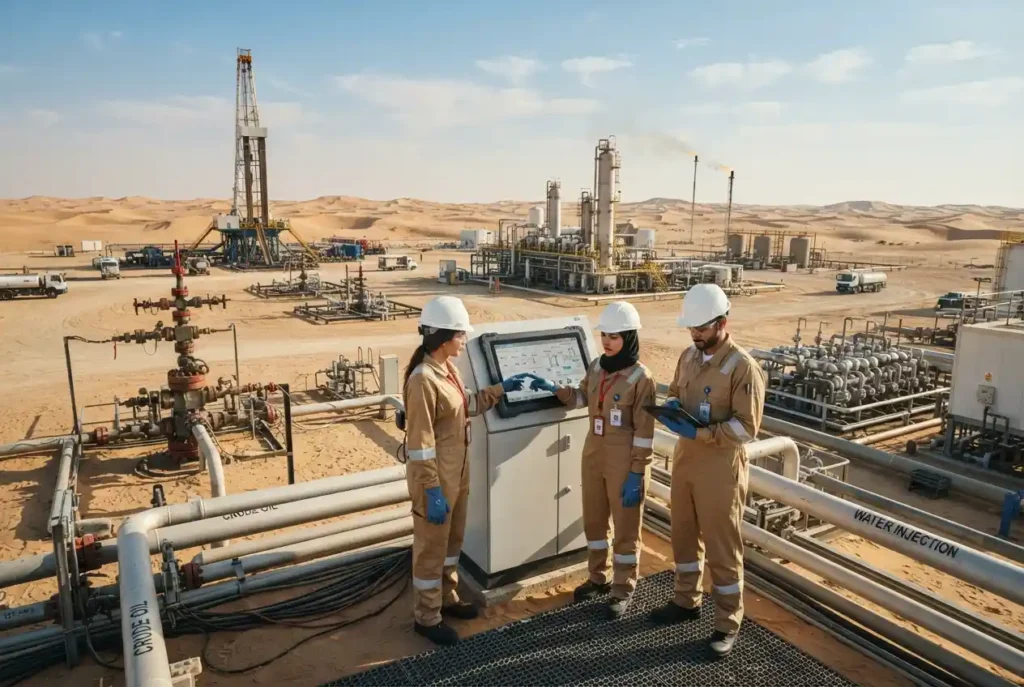
Oilfield technology plays a central role in the UAE‘s energy industry, supporting exploration, drilling, production, processing, maintenance, safety, and asset management. The sector has evolved far beyond traditional mechanical equipment, with modern oilfield operations increasingly combining engineering systems with automation, sensors, industrial software, data analytics, robotics, and remote monitoring.
The UAE’s position as a major energy producer has created demand for specialised technology companies and service providers capable of supporting complex oil and gas operations. These businesses supply equipment, engineering services, software, maintenance solutions, instrumentation, field services, and technologies designed to improve operational reliability and efficiency.
For companies researching oilfield technology in UAE, it is useful to understand both the conventional equipment used in oil and gas operations and the digital technologies changing how energy assets are monitored and managed.
What Is Oilfield Technology?
Oilfield technology refers to the equipment, engineering systems, software, and specialised processes used throughout the lifecycle of an oil or gas field. It can cover exploration, drilling, well completion, production, reservoir management, transportation, maintenance, inspection, safety, and decommissioning.
The sector brings together multiple engineering disciplines. Mechanical, electrical, petroleum, chemical, civil, instrumentation, automation, and software engineering can all contribute to modern oilfield operations.
Oilfield technology can range from heavy-duty drilling equipment and pumps to sophisticated sensors and software platforms that analyse information from wells and production facilities.
Why Oilfield Technology Matters in the UAE
The UAE’s energy industry operates large and technically complex assets. Maintaining these assets requires reliable equipment, skilled personnel, effective maintenance, accurate monitoring, and strong safety systems.
Technology can help operators improve visibility across their operations while supporting productivity and asset reliability. Digital systems can collect information from field equipment, while automation can control selected processes and provide operators with real-time information.
Technology also helps energy companies manage the enormous volumes of data generated by wells, pipelines, processing facilities, rotating equipment, and other assets.
Key Areas of Oilfield Technology
Oilfield technology covers many specialised areas, and companies operating in this market may focus on one or several parts of the energy value chain.
Drilling Technology
Drilling is one of the most technically demanding stages of oil and gas development. Drilling systems must operate under challenging conditions while maintaining accurate control over the well.
Modern drilling technology can include automated drilling controls, measurement systems, downhole tools, directional drilling technologies, drilling fluids equipment, and data systems used to monitor well conditions.
Technology can help drilling teams make better-informed decisions by providing information about pressure, temperature, formation characteristics, equipment performance, and other operational variables.
Well Completion Technology
After a well has been drilled, completion equipment is used to prepare it for production. Completion systems can include tubing, valves, packers, wellheads, safety equipment, and downhole components.
The selection of completion technology depends on reservoir characteristics, well design, production objectives, pressure conditions, and other engineering considerations.
Production Technology
Production technology helps operators bring hydrocarbons from wells to the surface and manage the flow through processing and transportation systems.
Pumps, valves, separators, compressors, flow meters, control systems, and monitoring equipment can all form part of a production environment. Reliable production equipment is essential because failures can affect output, safety, and maintenance schedules.
Petroleum Technology Company Services
A petroleum technology company may provide specialised products or services to upstream, midstream, or downstream energy businesses. The exact offering can range from drilling equipment and instrumentation to software, engineering consultancy, inspection, maintenance, and field services.
Because the petroleum technology market is highly specialised, businesses should assess a provider according to its specific technical capabilities and experience rather than simply categorising it as an oilfield supplier.
For complex projects, factors such as equipment certification, technical support, field experience, spare-parts availability, response times, safety procedures, and compatibility with existing infrastructure can all influence supplier selection.
Hydroserv Technology and Oilfield Equipment
Hydroserv Technology oilfield equipment is an example of the type of specialised offering businesses may encounter when researching oilfield technology suppliers in the UAE and wider Gulf market. Companies in this segment can support energy operations with equipment, engineering, maintenance, or field services.
Oilfield equipment suppliers often operate in demanding environments where reliability is essential. Equipment may need to function under high pressure, elevated temperatures, corrosive conditions, or remote operating circumstances.
Before selecting an equipment provider, operators should consider product specifications, certification, compatibility, maintenance requirements, service support, and the availability of replacement components.
Safwan Petroleum Technologies
Safwan Petroleum Technologies is another name associated with petroleum technology and oilfield services in the UAE market. Businesses researching suppliers should distinguish between equipment manufacturers, distributors, engineering companies, and service contractors because each can provide a different type of support.
A distributor may primarily supply equipment, while an engineering company may design systems and a field-service provider may install, maintain, or troubleshoot equipment at operational sites.
This distinction can make procurement more efficient because businesses can identify suppliers according to the actual requirement rather than approaching every oilfield company for the same type of service.
Digital Oilfield Technology
One of the biggest changes in the energy industry has been the development of the digital oilfield. Digital oilfield technology combines sensors, industrial networks, automation, software, cloud or edge computing, and analytics to provide operators with more detailed information about field operations.
Instead of relying solely on periodic manual inspections and reports, operators can collect continuous information from equipment and wells. This can improve visibility and support faster decision-making.
Industrial Sensors
Sensors can measure variables such as pressure, temperature, flow, vibration, equipment condition, and other operational parameters. Data from these sensors can be transmitted to monitoring systems for analysis.
Accurate sensor data is particularly important in industrial environments because decisions about maintenance and production may depend on the quality and reliability of the information being collected.
Remote Monitoring
Remote monitoring allows operators and engineering teams to observe equipment and field conditions without being physically present at every location. This can be valuable for geographically distributed assets and environments where frequent physical access is difficult.
Remote monitoring does not eliminate the need for field personnel. Instead, it can help teams prioritise inspections, identify abnormal conditions, and make better use of maintenance resources.
Predictive Maintenance
Predictive maintenance uses equipment data and analytical techniques to identify signs of potential failure. Vibration, temperature, pressure, operating hours, and other measurements can help indicate changes in equipment condition.
When implemented correctly, predictive maintenance can support better maintenance planning and reduce unexpected equipment downtime. However, the effectiveness of such systems depends on data quality, analytical models, equipment knowledge, and appropriate maintenance procedures.
Artificial Intelligence in Oilfield Operations
Artificial intelligence and machine learning are increasingly being explored across energy operations. AI systems can analyse large datasets and identify patterns that may be difficult to detect through manual analysis alone.
Potential applications include production optimisation, equipment monitoring, predictive maintenance, geological interpretation, drilling analysis, and anomaly detection.
AI should not be treated as a replacement for engineering expertise. Energy operations involve safety-critical systems and complex physical conditions, so automated recommendations need appropriate validation, oversight, and operational controls.
Automation and Control Systems
Industrial automation allows equipment and processes to operate according to predefined conditions. Control systems can monitor sensors, operate valves, manage pumps, and provide operators with information about system performance.
Automation can improve consistency and reduce the need for manual intervention in repetitive processes. It can also provide alarms when operating conditions move outside defined limits.
For large energy facilities, automation is often integrated with supervisory control and data acquisition systems and other industrial control technologies.
Oilfield Safety Technology
Safety is one of the most important considerations in oil and gas operations. Oilfield environments can involve pressure, combustible materials, heavy machinery, chemicals, elevated temperatures, and other hazards.
Technology can support safety through monitoring systems, emergency shutdown systems, gas detection, fire protection, access controls, equipment inspection, communications, and worker-location systems.
Wearable technology and connected devices can also provide additional information about workers and operating environments, although these systems must be designed carefully to protect both safety and data.
Inspection and Asset Integrity Technology
Oil and gas companies need to maintain the physical integrity of wells, pipelines, tanks, processing equipment, and other infrastructure. Inspection technologies help identify corrosion, cracks, leaks, wear, and other potential problems.
Non-destructive testing methods can examine materials without necessarily damaging the equipment being inspected. Remote inspection technologies, robotics, drones, and advanced imaging can also support inspections in difficult or hazardous environments.
Asset integrity programmes combine inspection results with engineering analysis, maintenance planning, operating data, and risk assessment.
Oilfield Equipment and Engineering Support
Technology is only effective when it is supported by appropriate engineering and maintenance. Oilfield operators often work with specialised contractors and suppliers to install, commission, inspect, repair, and upgrade equipment.
Engineering support can involve equipment selection, system design, hydraulic calculations, instrumentation, electrical integration, automation, installation planning, and commissioning.
For complex projects, coordination between equipment suppliers, engineering contractors, technology companies, and the operating company is essential.
How to Choose an Oilfield Technology Supplier in UAE
Choosing an oilfield technology company requires more detailed evaluation than a standard commercial technology purchase. The equipment and services may directly affect production, safety, compliance, and asset reliability.
Check Technical Experience
Look for experience with the specific equipment, operating environment, and application. Experience with a different type of oilfield technology does not automatically mean a supplier is suitable for every project.
Review Certifications and Standards
Energy-sector equipment can be subject to technical standards, certifications, and customer-specific requirements. Businesses should verify the documentation applicable to the equipment or service being purchased.
Assess Field Support
Oilfield operations may require rapid technical assistance. Supplier response times, field-service capabilities, spare-parts availability, and maintenance support can therefore be important procurement considerations.
Evaluate Equipment Compatibility
New equipment needs to work with existing infrastructure, control systems, power supplies, piping, instrumentation, and operating procedures. Compatibility should be evaluated before procurement.
Consider Lifecycle Costs
The initial purchase price does not always represent the true cost of industrial equipment. Installation, maintenance, spare parts, energy consumption, calibration, downtime, and eventual replacement can all affect total ownership cost.
Oilfield Technology and the UAE Energy Sector
The UAE’s energy industry is supported by large-scale infrastructure and specialised service companies. ADNOC is one of the country’s major energy organisations and operates across the oil and gas value chain.
The scale and complexity of the UAE energy sector create demand for technologies that can improve reliability, efficiency, safety, monitoring, and asset management. This includes both established oilfield equipment and newer digital solutions.
The country’s technology ecosystem is also expanding beyond traditional energy services. Companies are developing solutions that combine industrial engineering with software, analytics, automation, artificial intelligence, and connected devices.
Oilfield Technology and Sustainability
Technology is also becoming relevant to efforts to improve environmental performance across energy operations. Monitoring systems can provide better visibility into emissions, energy consumption, equipment efficiency, and operational conditions.
Automation and analytics can help identify inefficiencies and support more informed operational decisions. However, the environmental impact of a technology solution should be assessed across its full lifecycle rather than assumed simply because it is digital.
This broader relationship between engineering and sustainability is also reflected in the UAE’s growing interest in technology and sustainability.
The Future of Oilfield Technology in UAE
The future of oilfield technology is likely to involve greater integration between physical equipment and digital systems. Sensors, industrial connectivity, artificial intelligence, robotics, cloud platforms, edge computing, and advanced analytics can provide operators with more detailed information about assets and processes.
Digital twins may allow companies to create virtual representations of physical assets and use operational data to analyse performance. Robotics and remotely operated systems may also become more useful in hazardous or difficult-to-access environments.
At the same time, traditional engineering disciplines will remain fundamental. Digital technology works best when supported by sound equipment design, reliable infrastructure, skilled engineers, effective maintenance, and strong safety management.
Closing Remarks
Oilfield technology is an essential part of the UAE’s energy ecosystem, covering everything from drilling and production equipment to automation, sensors, cybersecurity, predictive maintenance, inspection, and artificial intelligence.
For businesses evaluating oilfield technology companies, the best supplier depends on the specific technical requirement. Equipment reliability, certifications, field experience, compatibility, support, safety, and lifecycle costs should all be considered before making a procurement decision.
As the UAE continues modernising its energy infrastructure, the integration of engineering and digital technology will remain important. The companies able to combine practical oilfield expertise with advanced technology will be well positioned to support the industry’s changing operational needs.