
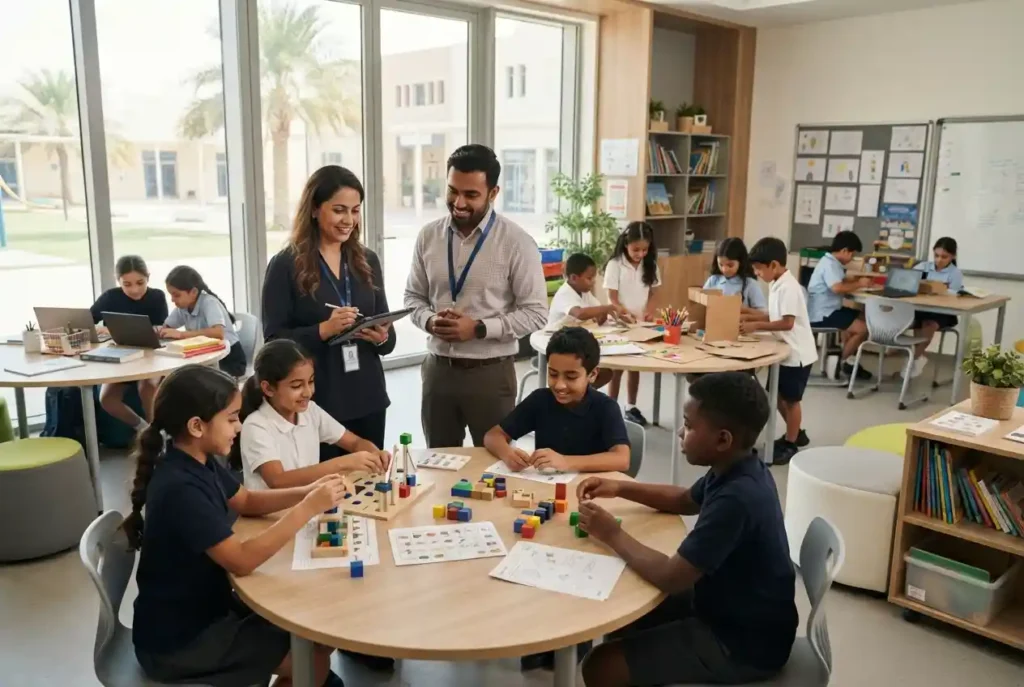
Educational psychology examines how people learn, develop, behave, and respond to educational environments. It brings psychological principles into education to help teachers, schools, families, and other professionals understand the factors that influence learning and student development.
In the UAE, educational psychology has particular relevance because schools serve students from diverse cultural, linguistic, social, and educational backgrounds. Learners may arrive with different levels of prior knowledge, different approaches to learning, and different forms of support. Understanding these differences can help educators create more responsive learning environments.
Educational psychology is not limited to diagnosing learning difficulties or addressing classroom behavior. It can also help educators understand motivation, memory, attention, cognitive development, social interaction, confidence, assessment, and student engagement.
For teachers developing their professional skills, knowledge of educational psychology can complement teacher training and provide a stronger foundation for making informed classroom decisions.
What Is Educational Psychology?
Educational psychology is the study of how psychological processes influence teaching and learning. It considers how students develop knowledge, how they respond to educational experiences, and how different learning environments can affect academic and personal development.
The field covers areas such as cognitive development, motivation, memory, attention, learning behavior, social development, assessment, and individual differences.
Teachers do not need to become psychologists to benefit from these concepts. A practical understanding can help educators think more carefully about why students respond differently to particular teaching methods or classroom situations.
Why Educational Psychology Matters in Education
Two students sitting in the same classroom may respond very differently to the same lesson. One may understand a concept immediately, while another may need additional explanation, examples, practice, or time.
Educational psychology helps teachers consider the reasons behind these differences rather than assuming that every learner should progress in exactly the same way.
This perspective can influence lesson planning, assessment, classroom communication, feedback, student motivation, and support strategies.
It can also help schools develop approaches that consider the whole learner rather than focusing exclusively on examination results.
Child Psychology Education and Learning
Child development is an important part of educational psychology. Students change rapidly as they move through early childhood, primary education, adolescence, and later stages of development.
Children’s cognitive abilities, communication skills, emotional regulation, social relationships, and independence develop over time. Teachers need to consider these developmental differences when planning activities and setting expectations.
For example, an activity that is appropriate for an older student may be too complex for a younger learner. Similarly, younger children may benefit from shorter activities, concrete examples, visual resources, and opportunities for movement.
Understanding inclusive education can further help educators consider how developmental and learning differences should be accommodated within classroom environments.
Learning Psychology and Student Development
Learning psychology explores how students acquire, retain, apply, and recall knowledge. It can help teachers understand why certain instructional approaches may be more effective for particular learning objectives.
Learning is influenced by many factors, including prior knowledge, attention, motivation, practice, feedback, environment, and the complexity of the material.
Teachers can use this understanding when deciding how to introduce new concepts, organize practice, review previous learning, and assess student understanding.
For example, breaking a complex concept into manageable stages can help students build understanding progressively. Providing opportunities to retrieve and apply knowledge can also strengthen learning.
The Role of Motivation in Learning
Motivation can influence how much effort students invest in an activity and how persistently they continue when the work becomes difficult.
Students may be motivated by different factors. Some enjoy mastering a subject, while others may respond strongly to achievement goals, personal interests, recognition, or future aspirations.
Teachers can support motivation by setting clear objectives, providing meaningful challenges, recognizing progress, and helping students understand why their learning matters.
Motivation should not depend entirely on rewards. Students also need opportunities to develop confidence and an internal sense of achievement.
Memory and Classroom Learning
Memory plays a central role in education because students need to retain knowledge before they can use it effectively. Teachers can support memory by revisiting important concepts, connecting new information with existing knowledge, and giving students opportunities to retrieve what they have learned.
Regular review can be particularly useful when students are expected to build knowledge progressively. New concepts often become easier to understand when learners can connect them with information they already know.
Teachers can therefore consider how learning is distributed across a term rather than treating each lesson as an isolated experience.
Attention and Student Engagement
Students cannot learn effectively when they are unable to focus on the relevant information. Attention can be affected by classroom distractions, task difficulty, fatigue, emotional factors, prior knowledge, and the structure of the lesson.
Teachers can support attention by providing clear instructions, breaking complex activities into manageable stages, using purposeful transitions, and varying appropriate instructional activities.
This connects closely with classroom management. A well-organized learning environment can reduce unnecessary distractions and help students focus on academic tasks.
Educational Psychology and Teaching Strategies
Psychological principles can inform practical teaching decisions. Teachers can use questioning, discussion, examples, demonstrations, guided practice, independent tasks, collaborative activities, and feedback according to the learning objective.
The important point is that no single method is ideal for every situation. Effective teachers select approaches according to the content, age group, student needs, and intended outcome.
Educators can explore different teaching strategies while using evidence from classroom experience to determine which approaches work best for their students.
Individual Differences Between Students
Students differ in prior knowledge, language proficiency, interests, confidence, learning pace, developmental stage, and educational experience. These differences can influence classroom participation and academic performance.
Recognizing individual differences does not mean lowering expectations. Instead, teachers can maintain meaningful learning goals while providing appropriate levels of support or challenge.
Differentiated tasks, additional examples, flexible grouping, visual resources, guided practice, and extension activities can all be used where appropriate.
Educational Psychology and Classroom Behavior
Student behavior can be influenced by academic difficulty, relationships, classroom expectations, motivation, developmental factors, and external circumstances. Educational psychology encourages teachers to consider possible causes rather than interpreting every behavior simply as a discipline problem.
A student who frequently avoids an assignment may not necessarily be unwilling to learn. The task may be too difficult, the instructions may be unclear, or the student may lack confidence.
Teachers can investigate the underlying issue while maintaining appropriate classroom expectations.
This approach complements positive classroom discipline by combining clear boundaries with an understanding of student behavior.
Supporting Students Through Feedback
Feedback is an important part of learning because it helps students understand what they have done well and what they can improve.
Effective feedback should be specific and connected to the learning objective. Rather than simply saying that an answer is good or bad, teachers can explain which aspect meets the objective and what the student should work on next.
Feedback can also encourage students to view mistakes as opportunities for improvement. This can be particularly useful when students are developing confidence in challenging subjects.
Educational Psychology and Assessment
Assessment provides information about student learning, but interpreting assessment results requires context. A test score may indicate that a student needs additional support, but teachers should consider classroom performance, prior learning, task design, and other relevant information.
Using multiple forms of assessment can provide a broader picture of student understanding. Teachers may combine questioning, observation, assignments, projects, quizzes, practical work, and formal assessments depending on the curriculum.
This approach can help educators distinguish between a student who has not learned a concept and one who understands it but struggles to demonstrate it through a particular assessment format.
The Importance of Social and Emotional Development
Students are not purely academic learners. Social relationships, confidence, emotional regulation, sense of belonging, and communication can influence their educational experience.
A supportive classroom can provide opportunities for students to work collaboratively, communicate respectfully, solve disagreements, and develop independence.
Teachers should remain within their professional role and refer serious emotional or psychological concerns to appropriately qualified professionals when necessary. Educational psychology can inform teaching practice, but it does not replace specialist psychological or clinical services.
Educational Psychology in Multicultural UAE Classrooms
UAE schools often bring together students from diverse cultural and linguistic backgrounds. This can create valuable opportunities for learning but also requires teachers to communicate thoughtfully.
Educators should avoid making assumptions about students based solely on cultural background. Individual experiences can differ considerably even among students who share a nationality or language.
Clear instructions, inclusive examples, respectful communication, and opportunities for students to express their perspectives can help create an environment where learners feel included.
Educational Psychology and Inclusive Learning
Inclusive learning requires teachers to recognize that students may need different forms of support to access the same educational goals.
Educational psychology can help teachers understand differences in development, attention, motivation, cognition, and learning behavior. This knowledge can contribute to more thoughtful classroom planning.
However, educators should not attempt to diagnose students based on classroom observations alone. When a student may require specialist assessment or intervention, schools should follow their established referral and support processes.
How Teachers Can Apply Educational Psychology
Teachers can begin with small, practical changes rather than trying to apply every psychological concept at once.
- Connect new learning to students’ existing knowledge.
- Break complex instructions into manageable steps.
- Give students opportunities to practice and retrieve important concepts.
- Use specific feedback instead of general praise.
- Provide appropriate levels of challenge.
- Observe how students respond to different instructional approaches.
- Encourage questions and productive discussion.
- Review lessons and adjust future instruction based on evidence.
These practices can become part of normal teaching rather than separate psychological interventions.
Teacher Training in Educational Psychology
Professional development can help educators develop a practical understanding of learning and development. Training may introduce concepts related to motivation, cognitive development, classroom behavior, assessment, inclusion, and student engagement.
For teachers, the most useful training connects theory with classroom application. Educators should be able to consider how a concept affects lesson planning, student communication, assessment, or classroom organization.
Ongoing teacher development can help educators refine these skills as they gain experience.
Educational Psychology and Curriculum Development
Psychological principles can also influence curriculum planning. Curriculum developers need to consider how students progress from foundational knowledge toward increasingly complex concepts.
Learning objectives should be appropriate for the educational stage, and content should be sequenced so that students have sufficient opportunities to build prior knowledge.
This makes educational psychology relevant not only to classroom teachers but also to professionals involved in curriculum development.
How Parents Can Support Learning at Home
Parents can apply simple learning principles without trying to become teachers or psychologists. Encouraging children to explain what they have learned, discussing questions, providing a quiet place for study, and recognizing effort can support learning.
Parents should also avoid comparing children unnecessarily. Students develop at different rates, and excessive comparison can affect confidence and motivation.
When concerns about learning or development persist, parents can discuss them with the child’s teacher or appropriate school professionals.
Educational Psychology and Lifelong Learning
The principles of learning remain relevant beyond childhood. Adults also need motivation, meaningful goals, appropriate practice, feedback, and opportunities to connect new knowledge with existing experience.
This makes educational psychology relevant to adult education and continuing professional development as well as school education.
Challenges in Applying Educational Psychology
One challenge is that psychological research can be complex, while classroom decisions often need to be made quickly. Teachers should therefore avoid oversimplifying psychological concepts or treating one theory as a universal solution.
Another challenge is individual variation. An approach that works well for one group of students may not produce the same results with another.
Professional judgment remains important. Teachers should observe students, review evidence, communicate with colleagues, and adjust their approaches when necessary.
The Future of Educational Psychology in UAE Education
As education becomes increasingly focused on student wellbeing, personalized learning, inclusion, digital learning, and future skills, understanding how students learn is likely to remain important.
Technology may provide educators with more information about student progress, but data should be interpreted carefully. Numbers and digital activity records cannot fully explain a student’s learning experience.
The human relationship between teacher and learner will continue to matter. Effective education combines academic knowledge, appropriate technology, professional judgment, and an understanding of student development.
Final Thoughts on Educational Psychology
Educational psychology provides educators with useful ways to understand learning, development, motivation, memory, attention, behavior, and individual differences. In UAE classrooms, these principles can be especially valuable when teachers work with diverse groups of learners.
The goal is not to turn every teacher into a psychologist. Instead, practical knowledge of learning and development can help educators make better decisions about instruction, assessment, classroom organization, feedback, and student support.
When combined with strong teaching practice, inclusive approaches, effective curriculum planning, and continuous professional development, educational psychology can contribute to learning environments where students are challenged appropriately, supported when they struggle, and encouraged to become increasingly independent learners.