
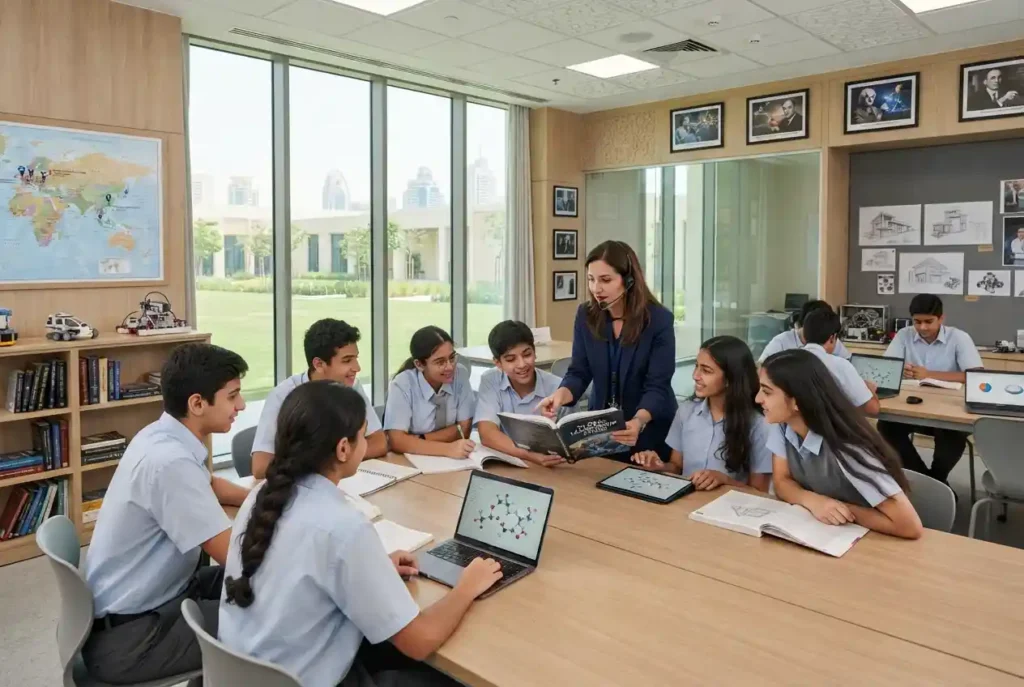
Education influencers are not limited to teachers, academic researchers, or social media creators. Around the world, political leaders, scientists, writers, public servants, advocates, and other prominent figures have demonstrated how education can shape careers, expand opportunities, and influence society.
For students and lifelong learners, studying the educational journeys of influential people can provide a useful perspective on persistence, curiosity, professional development, and the value of learning. Some followed traditional academic paths, while others faced significant barriers before reaching higher education.
This article explores the education backgrounds of several widely recognized figures, including Shashi Tharoor, Droupadi Murmu, Ajit Doval, Muhammad Ali Jinnah, Helen Keller, S. Somanath, and Sheikh Mohamed bin Zayed Al Nahyan.
What Makes Someone an Education Influencer?
An education influencer can be broadly understood as a person whose ideas, achievements, communication, or public work has a meaningful impact on how people think about learning and education.
The term does not necessarily mean that someone creates educational content on social media. A scientist who inspires students to pursue STEM subjects, a public figure who advocates for access to education, or a writer who encourages young people to read can all influence educational thinking.
In today’s digital environment, education influencers may include teachers on social platforms, university professors, career mentors, authors, entrepreneurs, researchers, and public figures. Their influence can come through formal teaching, public speaking, books, interviews, policy work, or personal example.
Shashi Tharoor Education
Shashi Tharoor education is notable for its combination of schooling in India and advanced higher education in the United States. According to his official biography, Tharoor attended schools in Mumbai and Kolkata before studying in Delhi and later moving to the United States for graduate education.
He completed a PhD at the Fletcher School of Law and Diplomacy at Tufts University in 1978. His official biography notes that he completed the doctorate at the age of 22.
His academic background was followed by a long international career at the United Nations, as well as political and literary work. His journey illustrates how education can become a foundation for careers spanning diplomacy, public policy, writing, and politics.
For students, his path is also an example of how education can cross national boundaries. Academic opportunities in different countries can expose learners to new institutions, professional networks, and perspectives.
Droupadi Murmu Education
Droupadi Murmu education is frequently discussed because her academic journey reflects determination in the face of social and economic challenges.
According to the official President of India profile, Murmu was born in Uparbeda in Odisha and began her education at the village primary school. She later continued her studies in Bhubaneswar and earned a Bachelor of Arts degree in Political Science and Economics from Ramadevi Women’s College in 1979.
Her educational journey is particularly significant because she became the first girl from her village to pass the matriculation examination and later became the first woman from her village to receive college education, according to official biographical material.
Education also became part of her professional life. Before entering a long public-service career, she served as an honorary teacher at Sri Aurobindo Integral Education & Research Centre in Rairangpur.
Ajit Doval Education
Ajit Doval education is associated with academic preparation in economics and a subsequent career in India’s security and public service establishment.
Doval’s career demonstrates that education can serve as a starting point for highly specialized professional work. His public profile is particularly relevant to students interested in civil services, strategic studies, international affairs, and national security.
For learners researching influential public servants, his journey can be considered alongside other figures whose academic preparation eventually led them into government and strategic roles. The broader lesson is that educational foundations can support careers that require analytical thinking, discipline, and continuous learning.
Muhammad Ali Jinnah Education
Muhammad Ali Jinnah education provides an important example from South Asian history. Jinnah received early education in Karachi before continuing his studies at the Sindh Madressatul-Islam and the Christian Missionary Society High School.
Official Pakistani government material records that Jinnah was educated at Sindh Madrassat-ul-Islam and the Christian Mission School before joining Lincoln’s Inn in London to study law.
Historical records also show that Jinnah entered Lincoln’s Inn in 1893 and subsequently qualified for the Bar. Lincoln’s Inn maintains archival information about his admission and legal studies.
His education was not restricted to formal classroom study. Historical accounts describe his extensive reading of political texts, biographies, and books while preparing for his legal career. His educational experience therefore combined formal legal training with independent reading and intellectual development.
Helen Keller Education
Helen Keller education remains one of the most widely discussed educational journeys in modern history. After losing both hearing and sight during early childhood, Keller faced significant barriers to communication and formal education.
Her education changed dramatically after Anne Sullivan became her teacher and mentor. Sullivan taught Keller through tactile communication, helping her develop language and eventually access reading and writing. Keller later attended the Perkins School and the Cambridge School for Young Ladies before entering Radcliffe College.
The American Foundation for the Blind records that Keller entered Radcliffe in 1900 and graduated with a Bachelor of Arts degree cum laude in 1904.
Her achievement demonstrates the importance of accessible education, individualized teaching, persistence, and support. Keller later became a writer, lecturer, and advocate, showing how education can expand a person’s ability to communicate ideas and participate in public life.
Her story remains relevant to modern discussions about inclusive education and accessibility. It also demonstrates why educational systems need to consider different ways of learning rather than relying on a single approach.
S. Somanath Education
S. Somanath education is particularly relevant for students interested in engineering, aerospace, space science, and STEM education.
Dr. S. Somanath earned a B.Tech in Mechanical Engineering from TKM College of Engineering in Kollam. He then completed a master’s degree in Aerospace Engineering at the Indian Institute of Science in Bengaluru and later earned a PhD from IIT Madras. ISRO’s official biography confirms these academic qualifications.
His educational background closely connects with his professional work in launch vehicle systems and space technology. He joined ISRO early in his career and went on to hold major technical and leadership positions, including Chairman of ISRO from January 2022 to January 2025.
His journey can be especially inspiring for students considering engineering careers because it shows how advanced technical education can lead to work on complex national and international scientific programs.
Mohammed Bin Zayed Al Nahyan Education
Mohammed bin Zayed Al Nahyan education includes schooling in Al Ain and Abu Dhabi followed by military education and training in the United Kingdom.
According to the official UAE government platform, Sheikh Mohamed bin Zayed attended schools in Al Ain and Abu Dhabi until the age of 18. In 1979, he joined the Royal Military Academy Sandhurst, where he received training that included armored operations, helicopter flying, tactical flying, and paratroop skills.
His education therefore combined general schooling with specialized military training. His official biography states that he has served as President of the UAE and Ruler of Abu Dhabi since May 2022.
For students in the UAE, his educational background also illustrates how learning can take place through different institutions and professional training environments rather than through a university degree alone.
What These Educational Journeys Have in Common
Although these figures lived in different periods and worked in very different fields, their educational experiences reveal several common themes.
Education Can Open Different Career Paths
Academic preparation does not always lead to a single type of career. Tharoor combined advanced education with diplomacy, politics, and writing. Somanath applied engineering education to space technology, while Keller transformed her education into a career in writing and advocacy.
Learning Does Not Stop With Formal Schooling
Formal qualifications provide an important foundation, but influential people often continue learning through professional experience, reading, research, training, and interaction with other experts.
Access and Support Matter
Keller’s experience demonstrates the importance of specialized teaching and accessibility. Murmu’s educational journey illustrates how determination and access to further education can affect an individual’s opportunities.
Education Can Influence Society
Education is not only about securing employment. It can prepare people to participate in public life, conduct scientific research, develop institutions, write influential works, and contribute to their communities.
Why Students Can Learn From Education Influencers
Studying the education backgrounds of influential figures can help students look beyond grades and certificates. It encourages them to consider how curiosity, discipline, reading, specialized training, and continuous development contribute to long-term success.
Students can also use these stories to explore different fields. Someone interested in science might investigate the academic path of S. Somanath, while a learner interested in writing and public affairs might explore Shashi Tharoor’s academic and professional journey.
Similarly, students interested in leadership can examine the educational experiences of political figures while considering how formal education interacted with practical experience.
Education Influencers in the Digital Age
The meaning of education influence continues to change. Today, a teacher with a strong online audience can potentially reach learners in many countries. Educational creators can explain difficult concepts through videos, podcasts, interactive lessons, and social media posts.
At the same time, established public figures can continue to influence students through books, speeches, interviews, institutions, and public policy.
This creates a much wider education ecosystem in which traditional institutions, digital learning resources, educators, and public personalities can all contribute to learning. Physical resources such as educational posters can complement digital resources by keeping key concepts visible in classrooms and study spaces.
How to Evaluate an Education Influencer
Not every person with an educational audience is a reliable source of information. Students should evaluate online education content carefully, particularly when it involves qualifications, scientific claims, career advice, or professional guidance.
- Check the person’s qualifications and professional background.
- Look for evidence supporting important claims.
- Prefer primary or authoritative sources for factual information.
- Distinguish personal opinions from established educational research.
- Be cautious about exaggerated promises concerning careers or academic results.
- Compare important information across credible sources.
Key Takeaways
Education influencers can come from many backgrounds. Their value is not simply determined by popularity but by the ideas, achievements, knowledge, and examples they bring to learners.
The educational journeys of Shashi Tharoor, Droupadi Murmu, Ajit Doval, Muhammad Ali Jinnah, Helen Keller, S. Somanath, and Mohammed bin Zayed Al Nahyan demonstrate different relationships between education and professional life.
For students, the most useful lesson is that education is a continuing process. Formal qualifications matter, but curiosity, independent learning, specialized training, resilience, and the ability to apply knowledge can be equally important in shaping a meaningful career.
As the UAE and the wider world continue to adopt new approaches to learning, students have more opportunities than ever to learn from educators, experts, institutions, and influential figures across borders.







