
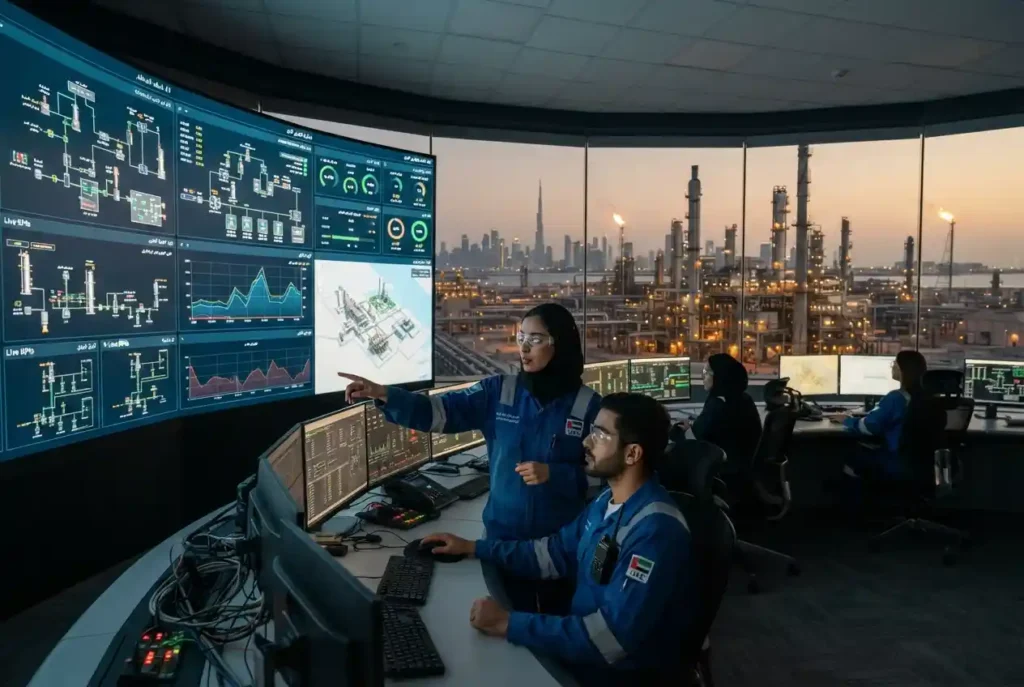
Aspen Technology, widely known as AspenTech, is a technology company focused on industrial software for asset-intensive industries. Its solutions are designed to help organizations improve the design, operation, maintenance, optimization, and performance of complex industrial assets.
The company is particularly relevant to sectors such as energy, chemicals, manufacturing, mining, utilities, pharmaceuticals, and other industries where operational efficiency, reliability, safety, sustainability, and asset performance are critical. For businesses in the UAE, these capabilities are especially relevant to industries that operate large-scale industrial facilities and infrastructure.
AspenTech is now part of Emerson. Emerson completed its acquisition of Aspen Technology on March 12, 2025, making AspenTech a wholly owned subsidiary of Emerson.
What Is Aspen Technology?
Aspen Technology developed from the Advanced System for Process Engineering project, an initiative associated with the Massachusetts Institute of Technology and the U.S. Department of Energy. The technology’s early focus was computer-based modeling and simulation for the chemical industry.
Over time, AspenTech developed a much broader portfolio of industrial software. Today, its technology is focused on helping asset-intensive organizations improve performance throughout the asset lifecycle, from engineering and design through operations and maintenance.
The company’s current positioning emphasizes industrial AI, asset performance management, process optimization, digitalization, data management, and sustainability.
Why Aspen Technology Matters to UAE Industries
The UAE has a significant industrial and energy ecosystem, including oil and gas, petrochemicals, utilities, manufacturing, infrastructure, and emerging industries focused on sustainability and advanced technology. These sectors depend on complex physical assets and highly coordinated operational processes.
For these organizations, even small improvements in production planning, maintenance, energy efficiency, reliability, or process control can have a meaningful operational impact. Industrial software can help companies make better use of data and engineering knowledge when managing these environments.
AspenTech’s portfolio is therefore relevant to UAE organizations looking beyond conventional business software and seeking technologies specifically designed for industrial operations.
Aspen Technology and Industrial AI
Artificial intelligence is increasingly being integrated into industrial environments, but industrial AI has different requirements from many consumer-facing AI applications. Industrial systems often need to work with engineering models, operational data, equipment behavior, process constraints, and domain-specific knowledge.
AspenTech describes its Industrial AI approach as combining AI algorithms with real-world domain expertise for process industries. Its technology portfolio includes AI-enabled capabilities intended to help organizations understand operational conditions, improve decision-making, and optimize industrial processes.
For UAE businesses, this can be relevant to facilities where operators need to make decisions based on large volumes of process and equipment information. Instead of treating AI as an isolated technology project, organizations can integrate it into existing engineering and operational workflows.
Asset Performance Management
Industrial organizations depend on equipment that must operate reliably. Production facilities can include pumps, compressors, turbines, heat exchangers, pipelines, electrical systems, processing units, and many other assets.
Asset performance management focuses on improving the reliability and performance of these assets while balancing maintenance requirements, operating costs, production objectives, and risk.
AspenTech provides asset performance management and monitoring technologies intended to help organizations understand asset conditions, identify potential problems, and make more informed maintenance and operational decisions. Its current product positioning also highlights asset performance optimization and reducing downtime.
Predictive Maintenance and Industrial Data
Traditional maintenance strategies can involve scheduled inspections and maintenance based on predetermined intervals. While these approaches remain useful, data-driven maintenance can provide additional insight into how equipment is actually performing.
Predictive maintenance uses operational information, equipment behavior, analytics, and other data sources to identify potential problems before they become major failures. The objective is not simply to predict an equipment issue but to help maintenance and operations teams make better decisions about when and how to intervene.
AspenTech’s industrial software portfolio includes technologies related to predictive analytics, asset performance, industrial data, and equipment lifecycle management.
Digital Twins and Industrial Digitalization
A digital twin can provide a digital representation of a physical asset, process, or system. In industrial environments, digital models can help engineers and operators understand how systems behave and evaluate possible changes before applying them to real operations.
Digital twin technologies can be particularly valuable in complex environments where physical testing may be expensive, disruptive, or difficult to perform. Organizations can use digital models alongside real operational data to improve analysis, planning, and optimization.
AspenTech’s technology portfolio includes digital twin and plant digitalization capabilities as part of its broader approach to industrial software.
Process Simulation and Engineering
Process simulation has long been an important part of AspenTech’s technology heritage. Engineers can use simulation software to model industrial processes, evaluate operating scenarios, analyze equipment behavior, and support process design decisions.
Simulation can help organizations assess potential changes before implementing them in a physical facility. This can be useful during engineering projects, plant optimization, troubleshooting, and operational planning.
AspenTech continues to offer engineering technologies covering areas such as process simulation, modeling, optimization, and specialized engineering applications.
Production Planning and Optimization
Industrial organizations must balance production targets, raw material availability, equipment constraints, market conditions, energy consumption, and operational requirements. Planning systems help organizations make decisions about what to produce, when to produce it, and how to use available resources efficiently.
AspenTech’s Aspen Unified portfolio includes production planning and scheduling technologies. Its current solutions combine planning, scheduling, production accounting, live plant information, and optimization capabilities.
For organizations in the energy and process industries, integrated planning can help bridge the gap between high-level production objectives and actual plant operations.
Aspen Technology and Energy Transition
Industrial organizations are under increasing pressure to improve resource efficiency and reduce environmental impact while maintaining operational performance. This creates a difficult balance between production, cost, reliability, and sustainability.
AspenTech’s current portfolio includes technologies related to sustainability and energy transition, including solutions associated with emissions reduction, carbon capture, microgrids, hydrogen, and other areas of industrial decarbonization.
These capabilities can be relevant to UAE organizations exploring ways to improve energy efficiency and reduce emissions across industrial operations while continuing to meet production and reliability objectives.
Aspen Technology for Oil and Gas Operations
Oil and gas remains an important part of the UAE’s industrial landscape. Operations in this sector involve complex reservoirs, processing facilities, pipelines, equipment, supply chains, and production systems.
Industrial software can support different stages of this environment, from reservoir modeling and engineering through production optimization, maintenance, planning, and operational analysis.
AspenTech’s technology portfolio includes solutions used across upstream, midstream, and downstream environments. Its current software positioning covers areas such as reservoir modeling, process optimization, asset performance management, industrial data, and production planning.
Aspen Technology in Manufacturing
Manufacturing companies increasingly rely on digital systems to improve productivity, quality, maintenance, and resource utilization. Connected equipment can generate large volumes of operational information, creating opportunities for advanced analytics and automation.
AspenTech supports asset-intensive manufacturing environments through technologies that connect engineering knowledge, operational data, process models, and optimization capabilities.
Manufacturers can use these technologies to evaluate production conditions, identify improvement opportunities, and make operational decisions using a combination of historical and real-time information.
Aspen Technology and Utilities
Utilities need reliable infrastructure because disruptions can affect large numbers of customers and businesses. Electricity, water, and other utility operations involve assets that must be monitored and maintained continuously.
Industrial software can help utilities analyze equipment performance, optimize operations, manage maintenance, and improve visibility across complex infrastructure.
AspenTech’s portfolio includes technologies for utilities and power-related environments, including asset performance, industrial data, operational optimization, and reliability-focused solutions. Its current materials also highlight digital solutions for utilities and power plant maintenance.
AspenTech Presence in the Middle East
AspenTech has established a regional presence serving customers across the Middle East and Africa. Its official contact information currently lists a Middle East and Africa location in Saudi Arabia, while an AspenTech support document identifies a regional support office in Dubai Internet City.
The company’s regional ecosystem also includes partners serving the Middle East and Africa. AspenTech’s partner network covers consulting, engineering, delivery services, technology, training, and solution sales, allowing customers to access additional expertise when implementing industrial software.
How Businesses Can Evaluate Aspen Technology Solutions
Industrial software investments should begin with a clearly defined operational challenge. Businesses should identify whether their priority is asset reliability, production optimization, process simulation, planning, maintenance, data management, sustainability, or another specific objective.
Organizations should also assess the quality and availability of their existing data. Advanced analytics and AI depend on appropriate operational information, and successful implementation often requires integration with existing control systems, historians, enterprise applications, and engineering databases.
Implementation expertise is another important factor. Complex industrial software may require engineering knowledge, process expertise, system integration, user training, and ongoing support. AspenTech maintains a partner ecosystem that includes organizations offering consulting, implementation, engineering, technology, and training services.
Aspen Technology Training and Skills Development
Industrial software delivers greater value when engineering and operations teams understand how to use it effectively. Training can help users become familiar with product capabilities, workflows, modeling techniques, and best practices.
AspenTech provides learning resources that include tutorials, computer-based training, product education, and other training materials.
For UAE organizations adopting specialized industrial software, employee training should therefore be considered part of the implementation strategy rather than an afterthought.
Aspen Technology and the Future of Industrial Digitalization
Industrial organizations are moving toward more connected operations in which engineering models, equipment data, operational systems, analytics, and AI work together. This evolution can help companies move from reactive decision-making toward more predictive and optimized operations.
The growing use of industrial AI also means that companies need to combine advanced algorithms with reliable industrial data and domain expertise. AspenTech’s current direction reflects this shift, with Industrial AI, digitalization, asset optimization, and sustainability forming important parts of its technology portfolio.
For UAE industries, these developments could support broader efforts to improve operational efficiency, reliability, resource utilization, and sustainability across complex industrial environments.
Essential Points
Aspen Technology, now operating as AspenTech within Emerson, occupies a specialized position in the enterprise technology market. Rather than focusing primarily on general-purpose business computing, its software is designed around the needs of asset-intensive industries and complex industrial operations.
Its capabilities span process simulation, asset performance management, industrial AI, digital twins, data management, production optimization, predictive analytics, and sustainability-related technologies. These areas make AspenTech particularly relevant to industries that form an important part of the UAE economy.
For organizations considering industrial digital transformation, the most effective approach is to connect technology investment with measurable operational objectives. When software, industrial data, engineering expertise, and workforce skills are brought together effectively, digital technologies can become an important part of improving long-term industrial performance.