
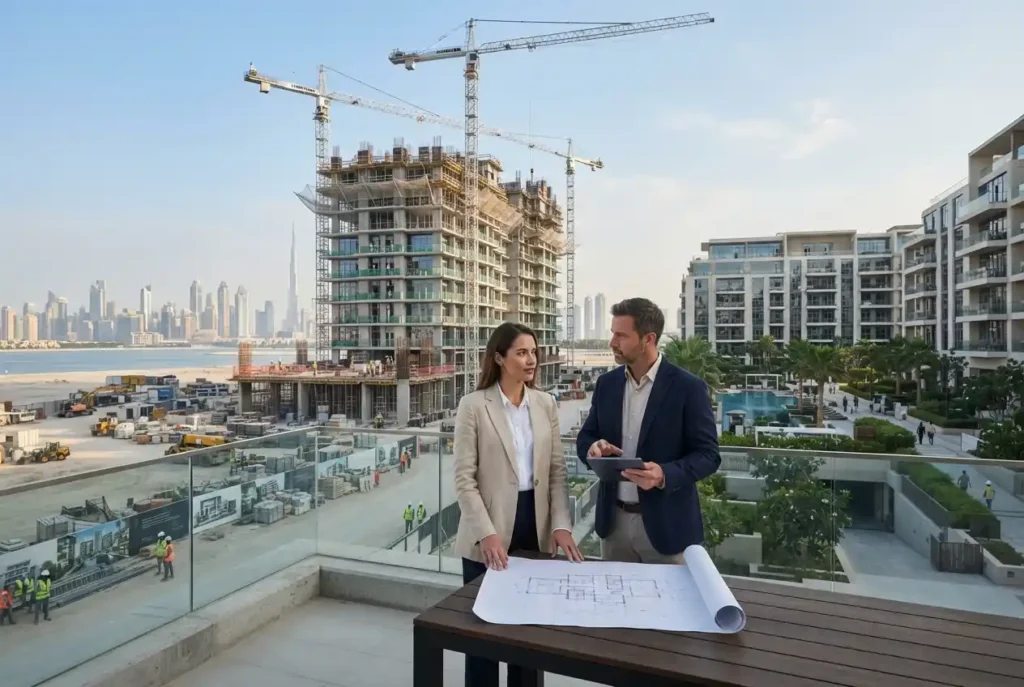
What is off plan property? It is a property purchased before the development has been completed. Instead of buying a finished apartment, villa, or townhouse that can be inspected immediately, the buyer purchases a unit based on information such as approved plans, specifications, development details, contracts, and the project’s expected completion timeline.
Off-plan property has become an important part of Dubai’s real estate market. Buyers can encounter off-plan apartments, villas, townhouses, branded residences, and larger master-planned developments at different stages of construction.
For first-time buyers, however, the off plan meaning can be confusing. An off-plan purchase is not simply a cheaper version of a ready property. It involves a different decision-making process, different risks, and a greater need to understand the developer, project documentation, payment structure, construction status, and applicable registration requirements.
What Is Off Plan Property?
Off-plan property generally refers to a real estate unit that is sold before construction has been completed. Depending on the project, construction may not have started, may be underway, or may be at an advanced stage.
The buyer typically makes a contractual commitment to purchase the property according to agreed terms. The final property is expected to match the specifications, plans, and contractual obligations associated with the development.
Because the finished unit may not yet exist, buyers need to evaluate more than the physical property. They also need to assess the developer, project, location, construction progress, payment schedule, and legal documentation.
What Does Off Plan Mean in Simple Terms?
The simplest off plan meaning is buying a property before it is ready for occupation.
For example, imagine a developer launches a residential tower containing hundreds of apartments. Construction may still be underway when sales begin. A buyer selects a specific apartment based on floor plans, specifications, views, project amenities, and other available information, then pays according to the agreed schedule.
The buyer does not receive a finished apartment immediately. Instead, the property is expected to be completed and handed over according to the project’s contractual and development arrangements.
What Are Off Plan Properties in Dubai?
What are off plan properties in Dubai? They are properties sold before completion within developments across the emirate. They can include apartments, villas, townhouses, and other residential or commercial units.
Dubai’s development market includes projects at different stages, from newly announced developments to properties approaching completion. This means the risks and considerations can vary substantially from one project to another.
Buyers should therefore avoid treating all off-plan properties as the same. A project nearing completion may present a different situation from one that has only recently been launched.
How Does Buying an Off Plan Property Work?
The exact process depends on the project and transaction, but an off-plan purchase commonly involves several stages.
1. Research the Development
Start by examining the project’s location, developer, property type, expected completion, amenities, unit layouts, and surrounding infrastructure.
Do not evaluate the project only from promotional material. Compare it with alternative developments in the same area.
2. Select a Unit
Buyers may choose a unit according to size, floor, orientation, view, layout, bedroom count, and price.
For investment purposes, consider whether the selected unit is likely to appeal to future tenants or buyers rather than focusing only on the launch price.
3. Review the Contract
The sale agreement and related documents should be reviewed carefully before signing. Buyers should understand the payment schedule, completion terms, cancellation provisions, obligations, fees, and other contractual conditions.
For significant transactions, independent legal or professional advice can be appropriate.
4. Make Payments
Off-plan developments often use structured payment plans. The schedule can vary significantly between projects and may include payments linked to dates or construction milestones.
Buyers should make sure they understand the full payment commitment rather than focusing only on the initial amount.
5. Follow Construction Progress
Once the purchase is underway, buyers can monitor the development’s progress through available official and developer channels.
6. Handover
When the development reaches the relevant completion stage, the property can move toward handover according to the contractual and regulatory process.
The buyer should inspect the property and address appropriate snagging or documentation matters before taking full possession.
Benefits of Buying Off Plan Property
Off-plan purchases can offer potential advantages, although none should be treated as guaranteed financial outcomes.
Access to New Developments
One obvious advantage is access to newly launched communities and buildings. Buyers may have the opportunity to select from a wider range of units during an early sales period.
Payment Plans
Some developers offer structured payment plans that spread payments across different stages. This can make the cash-flow profile different from purchasing a completed property that requires a larger payment upfront or follows a different financing structure.
Modern Specifications
New developments are often designed with contemporary layouts, facilities, building systems, and community amenities. Buyers may therefore prefer off-plan projects when they specifically want a newer property.
Potential Capital Appreciation
An investor may hope that the property’s market value increases between purchase and completion. However, appreciation is not guaranteed, and property prices can also decline.
Risks of Off Plan Property
Understanding the risks is just as important as understanding the potential benefits.
Construction Delays
A project may take longer to complete than originally expected. Delays can affect buyers who are planning to move into the property, refinance it, rent it out, or sell it after completion.
Market Changes
Property market conditions can change between the purchase date and handover. A buyer who expects the property’s value to rise may find that market prices have moved differently.
Developer Risk
The developer’s experience, financial position, delivery history, and ability to complete projects are important considerations. Buyers should conduct appropriate due diligence before committing funds.
Final Property Differences
The completed property may not feel exactly the same as the promotional images or early impressions. Buyers should carefully review contractual specifications and understand what is actually included.
Payment Obligations
An off-plan purchase creates financial commitments that must be met according to the agreement. Buyers should ensure they can comfortably manage the payment schedule under realistic financial scenarios.
How to Evaluate an Off Plan Developer
The developer should be one of the first things a buyer investigates. Look at the company’s previous developments, delivery history, reputation, project portfolio, and experience in the relevant property segment.
Do not rely solely on advertisements or sales presentations. Search for credible information and verify relevant project details through official channels.
It can also be useful to compare the developer’s completed projects with its current developments. This can provide a better understanding of the quality and style of properties it has actually delivered.
How Location Affects Off Plan Property
Location remains important even when the property has not yet been completed. Buyers should examine access to major roads, public transportation, schools, healthcare, retail, employment centers, entertainment, and other amenities.
Future infrastructure can also influence an area’s potential, but buyers should be cautious about treating planned developments as guaranteed benefits. Verify the status and timing of important infrastructure projects wherever possible.
A well-designed property in an unsuitable location may not perform as expected simply because it is new.
Off Plan Property vs. Ready Property
Understanding the difference between off-plan and ready property can help buyers decide which approach fits their circumstances.
Off-plan property is purchased before completion. Buyers may receive access to new developments and structured payment arrangements but must accept construction, timing, and market uncertainties.
Ready property has already been completed. Buyers can generally inspect the actual unit, building, surrounding community, and existing condition before purchase.
Neither option is automatically better. The appropriate choice depends on the buyer’s objectives, financial position, timing, risk tolerance, and intended use.
Off Plan Property for Investors
Investors may consider off-plan properties because of the potential for capital appreciation, new-project demand, payment structures, or future rental opportunities.
However, an investment calculation should include more than the purchase price. Consider transaction costs, financing, service charges, expected rental expenses, property management, furnishing, vacancy periods, and the potential resale market.
Projected rental yields should be treated as estimates rather than guarantees. Actual rental performance will depend on market conditions, property quality, location, competition, and tenant demand.
Dubai Registration and Official Property Information
Buyers should understand the official registration process associated with Dubai real estate transactions. The Dubai Land Department provides official real estate services and information, including services related to property registration.
Dubai Land Department’s official information also identifies a provisional registration process for off-plan sales, including registration through the Oqood system for applicable transactions. Buyers should verify current requirements and procedures directly through official channels.
Using official information is particularly important when dealing with project registration, ownership documentation, transaction procedures, and other legal matters.
Questions to Ask Before Buying an Off Plan Property
Before committing to an off-plan development, buyers should have clear answers to important questions.
- Who is the developer?
- What is the developer’s previous delivery record?
- Where exactly is the project located?
- What is the expected completion date?
- What payment schedule applies?
- What happens if construction is delayed?
- What is included in the purchase price?
- What service charges are expected?
- How is the project registered?
- What documentation is available?
- What are the applicable transaction and registration costs?
- What are the cancellation or default provisions?
These questions can help buyers move beyond sales presentations and understand the actual purchase commitment.
Common Off Plan Property Mistakes
- Choosing solely because of a discount: A lower launch price does not automatically mean better value.
- Ignoring the developer: The developer’s track record is an important part of due diligence.
- Underestimating the payment schedule: Buyers should understand every scheduled payment.
- Assuming appreciation is guaranteed: Property values can move in either direction.
- Ignoring service charges: Ongoing ownership costs can affect long-term affordability.
- Not checking project information: Buyers should verify relevant details through official sources.
- Relying entirely on marketing images: Promotional material should be compared with contractual specifications.
- Skipping professional advice: Independent legal or financial advice can be valuable for significant purchases.
Is Off Plan Property Right for You?
Off-plan property may suit buyers who are comfortable waiting for completion, understand the associated risks, and have the financial capacity to meet the payment schedule.
It may be less suitable for someone who needs a home immediately or who cannot comfortably manage uncertainty around completion timing and future market conditions.
Investors should also consider their investment horizon. Someone planning to hold a property for many years may evaluate an off-plan purchase differently from someone hoping to sell shortly after completion.
Summary
So, what is off plan property? It is real estate purchased before construction has been completed, with the buyer relying on project plans, specifications, contractual terms, and the developer’s ability to deliver the property.
The off plan meaning is straightforward, but evaluating an off-plan purchase requires careful research. Buyers should investigate the developer, location, project status, payment schedule, ownership and registration requirements, ongoing costs, and contractual protections.
For those considering off plan properties in Dubai, the most important principle is to balance opportunity with due diligence. New developments and flexible payment structures can be attractive, but construction delays, market movements, developer risk, and ongoing costs must also be considered.
Whether you are buying your first home or evaluating an investment, take time to understand the complete transaction before committing. A well-researched off-plan purchase should be based on verified information, realistic financial planning, and a clear understanding of both the potential benefits and the risks.







