
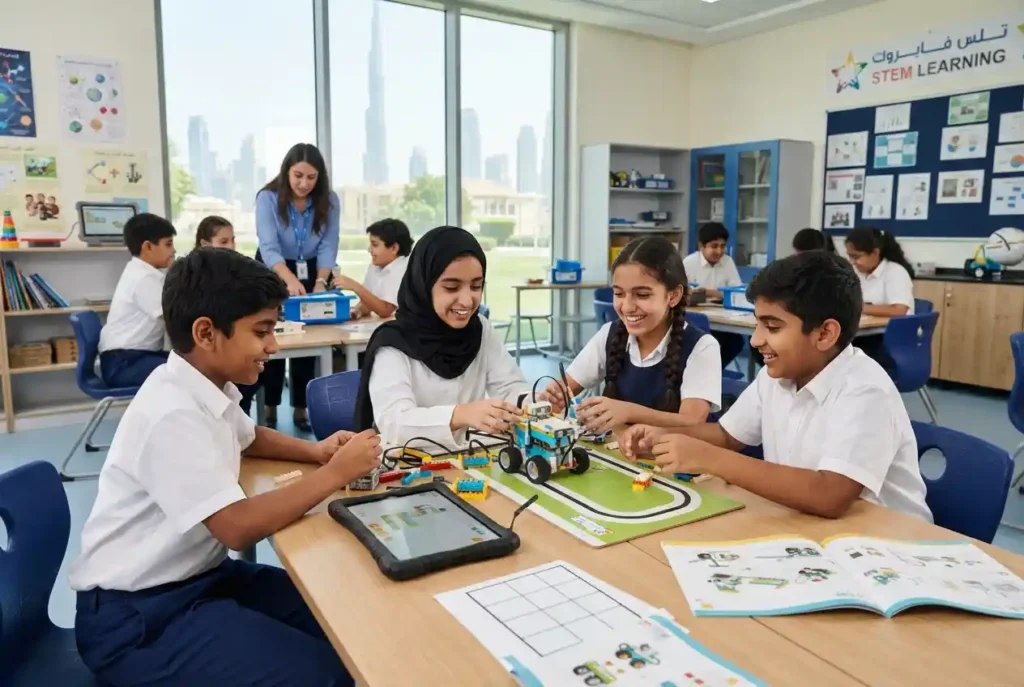
An educational robot toy can turn abstract ideas about technology, coding, engineering, and mathematics into something children can see, touch, build, test, and change. Instead of learning only from books or screens, students can experiment with physical objects and observe how their instructions affect movement and behavior.
Robotics-based learning has become increasingly relevant as schools and families look for practical ways to introduce children to STEM subjects. The UAE is also placing strong emphasis on technology, innovation, digital infrastructure, and future skills. The Ministry of Education’s current strategy includes adopting advanced technology to reinforce educational outcomes and aligning education with future skills.
However, buying a robot simply because it is marketed as educational does not guarantee meaningful learning. The value comes from how the toy is designed and how children are encouraged to use it. A good robotics activity should promote curiosity, experimentation, problem-solving, and reflection rather than simply asking children to press buttons.
What Is an Educational Robot Toy?
An educational robot toy is a robotics-based learning product designed to help children explore concepts such as coding, engineering, logic, sequencing, electronics, mathematics, or problem-solving through play.
These products range from simple programmable robots for younger children to advanced construction and coding systems designed for older students. Some robots are ready to use, while others require children to assemble components before programming or operating them.
The level of complexity should match the learner. A young child may benefit from a robot controlled through simple directional commands, while an older student may be ready for sensors, motors, block-based programming, mechanical construction, or more advanced coding.
Why Robot Toys Can Support STEM Learning
STEM learning involves science, technology, engineering, and mathematics. Robotics can bring several of these disciplines together in one practical activity.
When children build and program a robot, they may need to think about movement, distance, sequence, cause and effect, measurement, mechanical design, and logical instructions.
This hands-on approach can make technical concepts easier to explore because children can immediately see the consequences of their decisions. If a robot turns too early, moves in the wrong direction, or fails to detect an object, the student has a real problem to investigate.
That process naturally creates opportunities for experimentation.
How Robotics Encourages Problem-Solving
Problem-solving is one of the most useful skills developed through robotics activities. A robot rarely behaves perfectly on the first attempt, especially when children are building or programming it themselves.
Students can learn to:
- Identify what went wrong
- Break a larger problem into smaller steps
- Test possible solutions
- Change instructions or components
- Observe the result
- Try again when the first solution fails
This creates a practical form of learning through trial and error. Instead of viewing mistakes as simply incorrect answers, children can learn to treat them as information that helps them improve their design.
Educational Robot Toys and Coding
Coding is often one of the main learning objectives of robotics products. Younger learners may use visual programming systems where commands are represented by blocks or symbols. Older students can progress toward more advanced programming environments.
The physical robot provides immediate feedback. If a child creates a sequence that tells a robot to move forward, turn, and stop, the resulting movement shows whether the instructions work as intended.
This connection between code and physical action can help students understand programming concepts such as:
- Sequences
- Commands
- Loops
- Conditions
- Variables
- Events
- Debugging
The exact concepts depend on the robot and the child’s age, but the central idea remains the same: students write or arrange instructions and observe what happens.
Robotics Can Make Engineering More Practical
Engineering concepts can be difficult to explain purely through theory. Robotics gives children an opportunity to build something that physically performs a task.
A construction-based robot may require students to think about wheels, gears, motors, balance, structure, friction, and movement. If the robot does not move correctly, students can investigate whether the problem comes from the design, the programming, or the components.
This process encourages engineering thinking: define a problem, create a solution, test it, identify weaknesses, and improve the design.
Choosing an Educational Robot Toy by Age
Age recommendations should be considered carefully when choosing robotics products. A robot that is too simple may quickly become boring, while one that is too complicated can frustrate a beginner.
Early Learners
Young children generally benefit from simple controls, large components, clear cause-and-effect relationships, and activities that develop sequencing and basic problem-solving.
At this stage, the goal does not need to be teaching formal programming syntax. Children can begin by understanding that instructions can control movement and that changing an instruction can change an outcome.
Primary School Students
Primary-age students can often handle more structured challenges. Robotics kits may introduce block-based programming, basic sensors, construction, and simple problem-solving tasks.
Students can be asked to make a robot follow a route, avoid an obstacle, complete a challenge, or respond to a particular condition.
Older Students
Older learners can explore more advanced robotics concepts, including multiple sensors, motors, mechanical systems, programming logic, data collection, and collaborative engineering projects.
Classroom robotics systems can become particularly useful when students work in teams and divide responsibilities between programming, construction, testing, documentation, and presentation.
Educational Robot Toy vs Traditional Educational Toy
Traditional educational toys remain valuable. Building blocks, puzzles, science kits, board games, art materials, and mathematics manipulatives can all support learning without requiring electronics.
A robotics toy offers a different experience. It combines physical construction or interaction with technology and often allows children to see the result of programmed instructions.
The two approaches do not need to compete. A well-rounded learning environment can include both digital and physical resources.
For example, a student might learn a science concept using an educational app, reinforce important information with educational posters, and then use a robotics activity to apply problem-solving skills.
What Features Should Parents Look For?
Parents should evaluate the learning experience rather than choosing a robot based only on appearance or the number of technical features.
Programmability
A programmable robot usually offers more learning opportunities than a toy that performs a fixed sequence. Look for products that allow children to create or modify instructions.
Hands-On Construction
Some robotics systems allow children to build the robot themselves. Construction can add another layer of learning by introducing mechanical concepts and spatial reasoning.
Age-Appropriate Challenges
The robot should provide activities that are challenging without being overwhelming. Some products offer progressive difficulty, allowing children to move from simple commands to more complex projects.
Quality of Learning Materials
Instructions, lesson plans, project cards, and teacher resources can make a significant difference. A technically impressive robot may have limited educational value if children do not have clear activities to guide their experimentation.
Durability
Robotics activities involve building, testing, dismantling, and rebuilding. Components should be suitable for repeated use and appropriate for the intended age group.
Safety
Parents should check manufacturer age recommendations, component sizes, electrical requirements, battery specifications, and other safety information. Younger children may require supervision, particularly when a kit contains small components.
Educational Robot Toys in the UAE
The UAE’s education strategy provides a strong context for technology-based learning. The Ministry of Education identifies technology and innovation among its core values and lists advanced technology adoption as one of its strategic objectives.
The ministry has also continued investing in digital education and technology-focused initiatives. In 2026, the Ministry of Education and Hamdan Bin Mohammed Smart University launched a National AI Upskilling Programme for teachers, designed to strengthen educators’ ability to use AI technologies in classroom settings.
This wider focus on technology does not mean every child needs an advanced robot. Instead, it highlights the growing importance of helping students develop practical technology skills from an appropriate age.
STEM Education Dubai and Hands-On Learning
STEM education Dubai is increasingly connected with practical activities that allow students to experiment rather than only memorize information. Robotics can fit naturally into this approach because it combines multiple disciplines within a single project.
Schools and education providers can use robotics activities for classroom projects, STEM clubs, competitions, coding lessons, after-school programmes, and project-based learning.
For example, a class could be given a challenge to design a robot that moves an object from one location to another. Students would need to consider the mechanical design, movement, programming sequence, testing process, and final result.
Such an activity can involve mathematics, engineering, technology, teamwork, communication, and creative thinking at the same time.
Robotics Kits for Classroom Learning
Classroom robotics systems can be more advanced than consumer toys because they are designed for repeated educational use and structured activities.
In the UAE market, educational robotics products include systems designed for different age groups and learning levels. For example, VEX GO is marketed as a STEM construction system for students in approximately Grades 3–6, while VEX IQ is designed for older learners and provides components for building, operating, and coding robots.
These examples illustrate an important point: robotics is not one category with one difficulty level. Educators should choose systems based on curriculum objectives, student age, available teaching time, teacher expertise, and classroom budget.
How Teachers Can Use Robot Toys in Lessons
A robot can be used as part of a lesson rather than becoming the lesson itself.
A teacher might begin by introducing a problem, then ask students to design a solution using the robot. Students can work in small teams, test their designs, record observations, and explain what they changed.
Possible classroom challenges include:
- Program a robot to follow a specific route.
- Create a robot that responds to an obstacle.
- Build a vehicle that can carry a small object.
- Design a robot that completes a timed sequence.
- Compare two mechanical designs and explain which works better.
- Debug a program containing intentional errors.
These activities can encourage students to communicate their reasoning rather than simply produce a final result.
Robotics and Teamwork
Robotics projects are often well suited to collaborative learning. A group can divide responsibilities among programmers, builders, testers, researchers, and presenters.
Working in teams can teach children that successful projects require communication and coordination. Students may also discover that different team members have different strengths.
Teachers can rotate responsibilities so that every student has opportunities to work on both technical and communication aspects of the project.
Educational Robot Toys and Creativity
Robotics is sometimes viewed as purely technical, but creative thinking is an important part of building and programming robots.
Children can design the appearance of a robot, create new challenges, invent applications, develop stories around their creations, or find unconventional ways to solve a problem.
This is why robotics can contribute to STEAM-style learning, where arts and creative thinking are combined with science, technology, engineering, and mathematics.
Educational Toys Beyond Robotics
Robotics should be one part of a broader collection of educational toys. Children benefit from different types of play and learning experiences, and not every activity needs a digital component.
Construction sets can develop spatial reasoning, puzzles can encourage logical thinking, science kits can support experimentation, and art materials can develop creativity and fine motor skills.
Parents should therefore consider the child’s interests and developmental needs rather than assuming that the most technologically advanced toy is automatically the best educational choice.
Common Mistakes When Buying a Robot Toy
Several purchasing mistakes can reduce the educational value of a robotics product.
- Choosing a toy that is too advanced for the child’s current skills
- Buying based mainly on appearance or marketing claims
- Ignoring the quality of instructions and learning activities
- Failing to check age and safety recommendations
- Choosing a product without considering replacement parts
- Assuming a robot will teach coding automatically
- Providing the robot without opportunities for guided challenges
The best choice is usually the product that matches the learner’s current ability while providing a clear path toward more advanced challenges.
How Parents Can Make Robotics More Educational
Parents do not need to be robotics experts to support meaningful learning. They can ask children questions while they work rather than immediately solving problems for them.
Questions such as “Why did it turn here?”, “What would happen if you changed this instruction?”, or “How could you make it faster?” can encourage children to explain their reasoning.
Parents can also encourage children to document their experiments. Taking notes about what worked, what failed, and what changed can introduce basic scientific and engineering practices.
Robotics, Screen Time, and Hands-On Learning
One advantage of physical robotics activities is that they can connect digital instructions with real-world movement. Children may still use a computer, tablet, or controller, but the activity involves a physical object that responds to their decisions.
This does not automatically make robotics better than other screen-based learning. The educational value depends on the quality of the activity and the amount of active thinking involved.
The strongest robotics experiences encourage children to plan, build, program, test, and revise rather than simply watch a robot perform.
What Schools Should Consider Before Investing in Robotics
Schools considering robotics programmes should look beyond the cost of the kits themselves.
Important considerations include teacher training, curriculum alignment, storage, replacement components, software requirements, classroom space, student-to-kit ratios, lesson planning, and ongoing technical support.
A robotics programme is more likely to succeed when teachers understand how to connect the equipment with clear learning outcomes.
Schools can also start with a small pilot programme, evaluate student engagement and learning, gather teacher feedback, and then expand if the results justify further investment.
Last Thoughts
An educational robot toy can give children a practical introduction to coding, engineering, technology, mathematics, and problem-solving. Its greatest value comes from allowing learners to experiment with ideas and immediately observe the consequences of their decisions.
For UAE families and schools, robotics fits naturally into a wider movement toward technology-enabled and future-focused education. The UAE Ministry of Education’s current strategy emphasizes technology, innovation, future skills, and improved educational outcomes, creating a supportive environment for thoughtful STEM initiatives.
However, robotics should not be treated as a replacement for teachers or traditional learning resources. A well-designed robotics activity works best when it forms part of a broader educational experience that includes reading, discussion, experimentation, collaboration, and reflection.
Whether a family chooses a simple programmable robot for home use or a more advanced classroom robotics system, the goal should remain the same: give children meaningful opportunities to ask questions, solve problems, test ideas, and learn from what happens next.







