
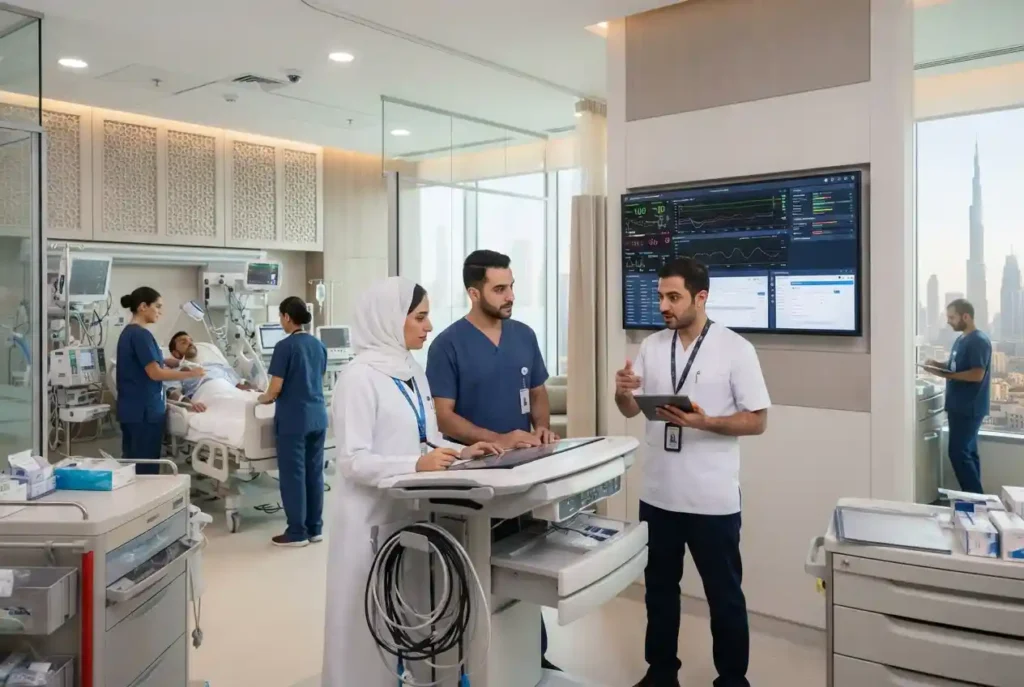
Healthcare technology is changing how hospitals, clinics, laboratories, pharmacies, insurers, and other healthcare organizations operate in the UAE. Digital systems are increasingly being used to manage patient information, appointments, clinical workflows, medical records, communication, billing, diagnostics, and operational decision-making.
The growth of healthcare technology is not simply about introducing new devices or replacing paper-based processes. Modern healthcare organizations need connected systems that can support healthcare professionals, improve operational efficiency, protect sensitive information, and create more convenient experiences for patients.
This broader transformation includes healthcare software, cloud platforms, healthcare SaaS, digital patient services, data analytics, telehealth, connected medical devices, artificial intelligence, and systems that allow different parts of a healthcare organization to communicate with each other.
For UAE organizations considering digital transformation, understanding these technologies and their practical applications is essential.
What Is Healthcare Technology?
Healthcare technology refers to the tools, systems, software, devices, and digital infrastructure used to support healthcare delivery and administration. It includes both clinical and non-clinical technologies.
Traditional examples include medical imaging systems, diagnostic equipment, patient monitoring devices, laboratory technology, and specialized clinical tools. The modern healthcare technology landscape has expanded to include electronic health records, cloud computing, artificial intelligence, healthcare applications, remote consultations, digital payment systems, analytics, cybersecurity, and connected devices.
The objective is ultimately to support better healthcare operations. Technology can help professionals access relevant information, automate repetitive administrative tasks, coordinate services, and communicate more efficiently.
Why Healthcare Technology Matters in the UAE
The UAE has a diverse healthcare environment that includes large hospitals, specialist medical centers, private clinics, laboratories, pharmacies, insurance providers, and government healthcare organizations. These organizations need technology capable of supporting different workflows and levels of complexity.
Digital systems can help healthcare providers manage increasing volumes of information while maintaining appropriate access and security controls. They can also support communication between departments and improve visibility into operational performance.
For healthcare leaders, technology is therefore becoming part of strategic planning rather than simply an IT department responsibility.
Healthcare Software and Its Role in Modern Healthcare
Healthcare software is one of the most important components of digital healthcare. Depending on the organization’s needs, software can support patient records, appointments, billing, pharmacy management, laboratory operations, medical imaging, staff scheduling, inventory, reporting, and clinical documentation.
Healthcare software can be developed for a specific organization or offered as a configurable commercial platform. The right approach depends on factors such as the organization’s size, workflow complexity, budget, existing technology, integration requirements, and long-term plans.
Electronic Health Records
Electronic health record systems allow healthcare organizations to manage patient information digitally. Instead of relying on disconnected paper records, authorized professionals can use digital systems to access relevant information within an organization’s workflow.
Effective implementation requires careful attention to data accuracy, user access, interoperability, security, staff training, and system availability.
Hospital Management Software
Hospital management platforms can support administrative and operational activities across departments. Depending on the system, features may include registration, appointments, billing, inventory, reporting, staff management, and coordination between different services.
Laboratory Information Systems
Laboratories rely on specialized technology to manage test orders, samples, results, workflows, and reporting. Connecting laboratory systems with other healthcare platforms can reduce manual data entry and improve information flow.
Pharmacy Management Systems
Pharmacy software can assist with inventory, prescriptions, dispensing, billing, and related operational processes. Integration with clinical systems can make medication-related information easier to manage across healthcare workflows.
What Is Healthcare SaaS?
Healthcare SaaS, or Software as a Service, refers to software delivered through a hosted or subscription-based model rather than requiring the customer to manage the entire software infrastructure locally.
For healthcare organizations, SaaS can provide advantages such as easier deployment, centralized updates, scalable infrastructure, and potentially lower initial infrastructure requirements. However, healthcare organizations must carefully evaluate security, data governance, integration, availability, regulatory requirements, vendor responsibilities, and contractual terms before adopting a SaaS platform.
Not every healthcare application is suitable for every SaaS model. A hospital dealing with complex clinical workflows may have very different requirements from a small medical clinic or specialist practice.
Benefits of Healthcare SaaS for UAE Organizations
When appropriately designed and implemented, SaaS can help healthcare organizations access modern software without maintaining all underlying infrastructure themselves.
- Faster deployment compared with some traditional implementations
- Centralized software maintenance and updates
- Scalable access for growing organizations
- Potentially lower upfront infrastructure requirements
- Remote accessibility where appropriate
- Integration with other cloud-based systems
These benefits should be balanced against cybersecurity, data protection, business continuity, integration, and vendor dependency considerations.
Digital Healthcare Is More Than Telemedicine
The term digital healthcare is sometimes associated mainly with telemedicine and remote consultations. In reality, it covers a much wider range of technologies and services.
Digital healthcare can include online appointment systems, electronic medical records, digital prescriptions, remote monitoring, patient portals, mobile applications, healthcare analytics, automated communication, virtual consultations, and connected medical devices.
The best digital healthcare strategies connect these capabilities rather than treating each service as an isolated project.
How Digital Healthcare Can Improve Patient Experience
Patients increasingly expect convenient digital interactions in many areas of their lives, and healthcare is no exception. Technology can simplify certain parts of the patient journey without replacing the importance of professional medical care.
Online Appointment Management
Digital appointment platforms can make it easier for patients to identify available services and manage appointments. Automated reminders can also help organizations manage scheduling more efficiently.
Digital Communication
Healthcare organizations can use secure digital communication channels to provide appropriate updates, instructions, appointment information, and other administrative communications.
Patient Portals
Patient portals can provide authorized access to selected health information and services. Depending on the implementation, patients may be able to view information, communicate with providers, manage appointments, or access other digital services.
Remote Monitoring
Connected devices can allow certain health measurements to be collected outside traditional clinical settings. Where clinically appropriate, this can support ongoing monitoring and follow-up.
Healthcare Technology and Artificial Intelligence
Artificial intelligence is becoming an important area of healthcare technology research and development. AI systems can potentially support medical imaging analysis, administrative automation, clinical decision support, documentation, data analysis, and other healthcare applications.
However, healthcare organizations should distinguish between promising technology and clinically validated applications. AI tools require appropriate evaluation, governance, human oversight, privacy safeguards, and consideration of potential errors or biases.
AI should generally be viewed as a technology that can support healthcare professionals rather than an automatic replacement for professional clinical judgment.
Healthcare Data and Analytics
Modern healthcare organizations generate large volumes of data. This information can include patient records, laboratory results, imaging data, appointment information, claims, inventory records, financial information, and operational metrics.
Healthcare analytics can help organizations turn this information into useful insights. Management teams may analyze appointment patterns, resource utilization, patient flow, operational costs, or service demand.
The value of analytics depends heavily on data quality. If information is incomplete, inconsistent, duplicated, or poorly structured, sophisticated analytical tools may still produce unreliable results.
Interoperability Is a Major Healthcare Technology Challenge
Healthcare organizations rarely operate with a single technology platform. Hospitals may use separate systems for electronic records, laboratories, imaging, pharmacy, billing, insurance, scheduling, and other functions.
These systems need to communicate effectively when information must move between them. This is known as interoperability.
Without appropriate integration, staff may need to enter the same information multiple times or switch between disconnected systems. This can increase administrative workload and create opportunities for errors.
Healthcare technology providers therefore need to consider integration from the beginning of a project rather than treating it as an optional feature added later.
Cybersecurity in Healthcare Technology
Healthcare organizations manage sensitive information, making cybersecurity a fundamental part of digital transformation.
A technology platform should be evaluated not only on its features but also on how it protects information and controls access. Healthcare organizations should consider authentication, authorization, encryption, backups, monitoring, vulnerability management, incident response, and business continuity.
Employees are also an important part of cybersecurity. Staff training can help reduce risks associated with weak passwords, phishing, inappropriate access, accidental disclosure, and other common security problems.
Organizations researching the UAE market should consider applicable UAE laws, regulatory requirements, and sector-specific guidance before implementing systems that process health information.
Cloud Computing in Healthcare
Cloud technology has become an important part of modern IT infrastructure. Healthcare organizations can use cloud-based infrastructure and applications for storage, computing, software delivery, collaboration, backup, analytics, and other functions.
Cloud adoption can provide scalability and flexibility, but healthcare organizations still need to understand where information is stored, who can access it, how it is protected, and what responsibilities belong to the cloud provider versus the healthcare organization.
A cloud strategy should therefore be developed around security, compliance, resilience, performance, integration, and business requirements rather than simply choosing a cloud service because it is technologically modern.
Connected Medical Devices and Smart Healthcare
Medical devices are becoming increasingly connected. Patient monitors, diagnostic equipment, imaging systems, wearable devices, and other technologies can generate digital information that may be incorporated into broader healthcare workflows.
This creates opportunities for more connected clinical environments, but it also creates additional technical and security considerations. Each connected device can become part of an organization’s technology environment and therefore needs appropriate management.
Smart hospital environments can combine connected medical equipment with digital infrastructure, allowing clinical teams and administrators to manage information more efficiently. The success of such environments depends on reliable connectivity, appropriate integration, staff training, and strong technical support.
How Healthcare Organizations Should Choose Technology
Healthcare organizations should begin with the problem rather than the product. Before purchasing a platform, decision-makers should identify the workflow they want to improve and establish measurable objectives.
Important questions include:
- What healthcare or administrative problem will the technology solve?
- Who will use the system?
- Can it integrate with existing platforms?
- How will sensitive information be protected?
- What training will staff require?
- Can the solution scale as the organization grows?
- What support is available after implementation?
- What are the total ownership and maintenance costs?
- How easily can information be exported or transferred if circumstances change?
These questions can help prevent organizations from selecting technology based solely on attractive interfaces or long feature lists.
Healthcare Technology Companies in the UAE
The UAE healthcare technology ecosystem includes global technology vendors, specialist healthcare software providers, medical technology companies, systems integrators, cybersecurity firms, cloud providers, digital health startups, and organizations offering managed healthcare solutions.
One example is Emitac Healthcare Solutions, which has developed a broad healthcare portfolio covering areas such as critical care and patient monitoring, imaging and ultrasound, oncology and nuclear medicine, neurology and surgical solutions, CSSD, physiotherapy, dental health, technical services, and healthcare IT. Its current corporate profile also highlights digital health transformation, healthcare informatics and technology, digital health and AI solutions, and managed services.
This type of integrated model demonstrates why healthcare technology should not always be viewed as software alone. A modern healthcare project can involve medical equipment, infrastructure, digital systems, implementation, maintenance, training, and ongoing technical support.
Businesses can review the official Emitac Healthcare Solutions website when researching its current healthcare portfolio and services.
What to Look for in a Healthcare Technology Provider
Selecting a technology partner requires careful evaluation. A healthcare provider should consider the vendor’s technical capabilities alongside its understanding of healthcare workflows.
Healthcare Experience
A company that understands healthcare environments may be better positioned to identify practical requirements around clinical workflows, equipment integration, information management, and user needs.
Implementation Capability
Buying software or equipment is only one part of a technology project. Healthcare organizations should understand who will handle configuration, installation, integration, testing, training, documentation, and post-launch support.
Integration Expertise
The ability to connect new technology with existing systems can be critical. A platform that operates effectively in isolation may create additional administrative work if it cannot exchange information with other essential systems.
Security and Governance
Healthcare organizations should assess how vendors approach information security, user permissions, data protection, backups, monitoring, and incident response. Responsibilities should be clearly documented before implementation.
Ongoing Support
Healthcare systems often operate continuously, making reliable support important. Organizations should review service-level arrangements, maintenance processes, response procedures, training, and upgrade policies before signing a long-term agreement.
Healthcare Technology and Healthcare Management
Technology decisions increasingly affect healthcare management. Hospital executives and healthcare managers need to understand how digital systems influence staffing, patient flow, costs, service quality, data, and operational performance.
This is one reason healthcare technology is becoming relevant to professionals pursuing healthcare management careers and education. Managers may be involved in technology procurement, digital transformation projects, system implementation, process redesign, and performance analysis.
Professionals interested in this area can also explore healthcare management courses to understand how management education connects with the changing healthcare sector.
Healthcare Technology and Healthcare Recruitment
The growth of digital healthcare is also changing the skills healthcare organizations need from their employees. Technology-related positions can include health information specialists, healthcare IT professionals, data analysts, cybersecurity specialists, software engineers, digital transformation managers, and project managers.
Clinical professionals may also increasingly interact with electronic systems, connected devices, digital records, and technology-enabled workflows as part of their daily responsibilities.
Organizations looking for specialized professionals can use healthcare recruitment agencies as one channel for identifying candidates, particularly when positions require a combination of healthcare knowledge and technical expertise.
Future Trends in Healthcare Technology
The UAE healthcare technology market is likely to continue evolving as organizations adopt more connected systems and digital services.
Several areas are particularly relevant:
- Artificial intelligence and machine learning
- Cloud-based healthcare platforms
- Healthcare cybersecurity
- Remote patient monitoring
- Digital patient engagement
- Healthcare analytics
- Interoperable healthcare systems
- Automation of administrative processes
- Connected medical devices
- Personalized digital healthcare services
- Smart hospital infrastructure
- Digital health and clinical decision-support tools
The most successful implementations will likely be those that combine technology with strong clinical workflows, effective governance, staff training, and clear patient benefits.
Challenges of Adopting Healthcare Technology
Digital transformation can provide significant opportunities, but implementation is not always straightforward. Healthcare organizations may encounter resistance to change, integration difficulties, legacy systems, training requirements, cybersecurity concerns, and unexpected costs.
Staff adoption is particularly important. A technically capable platform can still underperform if healthcare professionals find it difficult to use or if the system does not align with established workflows.
For this reason, healthcare technology projects should involve end users early in the planning process. Doctors, nurses, administrators, technicians, IT teams, and other relevant stakeholders can provide valuable insight into how technology will affect day-to-day operations.
How the UAE Healthcare Sector Can Benefit From Digital Transformation
The strongest healthcare technology strategies focus on practical outcomes. These can include improving access to information, reducing unnecessary manual work, strengthening communication, supporting clinical workflows, improving operational visibility, and making selected services more convenient for patients.
Digital transformation can also create a stronger foundation for future technologies. Once an organization has reliable data structures, secure infrastructure, interoperable systems, and digitally capable staff, it becomes easier to evaluate newer technologies as they mature.
This is particularly important because healthcare technology is changing quickly. Organizations should avoid building systems that depend entirely on one short-term technology trend and instead prioritize flexible foundations that can evolve.
Wrapping Up
Healthcare technology is becoming an essential part of modern healthcare in the UAE. From healthcare software and SaaS platforms to digital patient services, analytics, connected medical devices, cloud infrastructure, artificial intelligence, and cybersecurity, technology now influences almost every part of healthcare operations.
For healthcare organizations, adopting technology should not be about following every new trend. The priority should be identifying genuine operational and clinical needs and selecting solutions that are secure, scalable, interoperable, practical, and suitable for the organization’s users.
Healthcare technology providers such as Emitac Healthcare Solutions illustrate how modern healthcare projects can combine medical technology, digital health, healthcare IT, infrastructure, technical support, and lifecycle services. At the same time, the wider market continues to develop across software, SaaS, digital healthcare, analytics, cybersecurity, and connected healthcare systems.
As the UAE healthcare sector continues its digital transformation, healthcare technology will increasingly connect clinical services, administration, data, infrastructure, and patient experiences. Organizations that approach this transformation strategically can build stronger digital foundations while creating healthcare environments that are more connected, efficient, secure, and responsive to changing needs.