
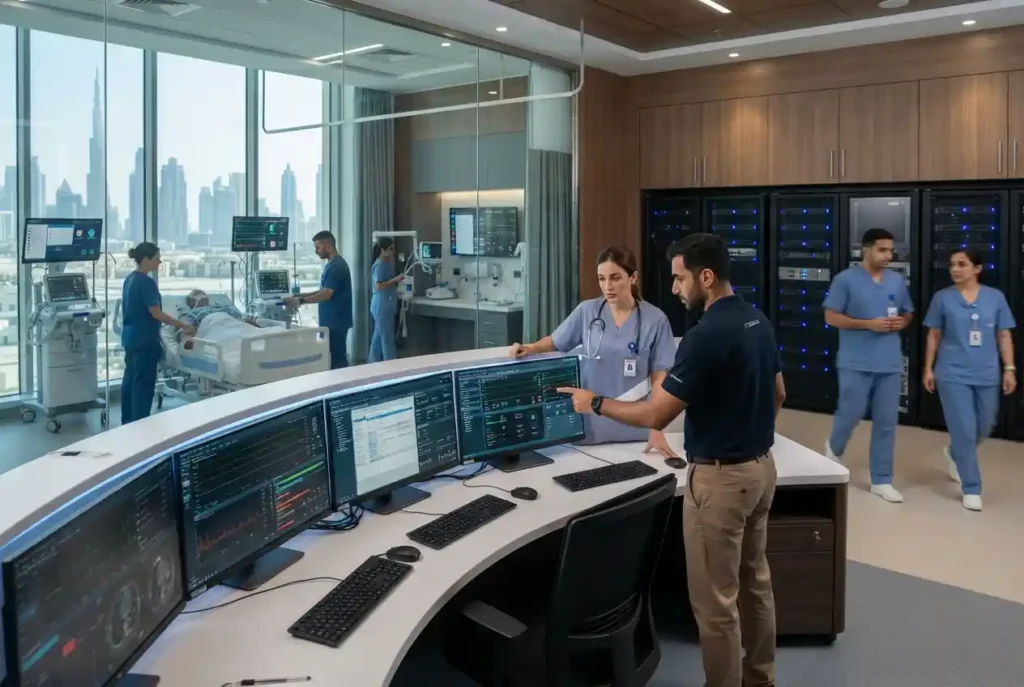
Healthcare is becoming increasingly dependent on technology. Hospitals, clinics, laboratories, insurers, and other healthcare organizations now rely on digital systems to manage clinical information, medical equipment, patient services, operational workflows, and communication. As this transformation continues, healthcare IT companies in the UAE are becoming an important part of the country’s broader healthcare ecosystem.
Among the names associated with this sector is Emitac Healthcare Solutions, a UAE-based healthcare solutions provider with experience spanning clinical and technology-related solutions. Its work illustrates how healthcare organizations increasingly need a combination of medical technology, information systems, infrastructure, consulting, and implementation support rather than isolated products.
For businesses researching healthcare technology providers, understanding the different types of companies operating in this space can make it easier to identify the right technology partner for a particular requirement.
## What Are Healthcare IT Companies?
Healthcare IT companies provide technology, systems, services, and expertise that support healthcare organizations. Their work can cover areas such as hospital information systems, electronic health records, infrastructure, cybersecurity, data management, digital patient services, medical technology integration, and software implementation.
The sector is broader than traditional software development. A healthcare IT project may involve hardware, networking, clinical applications, data integration, cloud services, cybersecurity, user training, and ongoing technical support.
This makes healthcare IT particularly important in the UAE, where healthcare providers operate across large hospitals, specialist centers, clinics, laboratories, pharmacies, and other facilities.
## Understanding Emitac Healthcare Solutions
Emitac Healthcare Solutions is associated with healthcare technology and medical solutions in the UAE. Public company information describes its experience with clinical and IT solutions deployed across government, semi-government, military, and private hospitals in the wider MENA region. The business is also associated with healthcare equipment, planning, technology optimization, and healthcare infrastructure services.
The broader Emitac organization describes its technology activities as including digital transformation, managed services, platforms, products, consulting, and technology-enabled business solutions. Its healthcare work therefore sits within a wider technology and enterprise-solutions environment.
This type of integrated approach is significant because healthcare providers rarely need technology in isolation. A hospital may need medical equipment to communicate with digital systems, secure infrastructure to support applications, and technical expertise to keep those systems operating reliably.
## Why Healthcare IT Matters in the UAE
Healthcare providers generate and process large amounts of information every day. Patient records, diagnostic results, appointments, prescriptions, insurance information, laboratory data, billing information, and operational records all need to be managed appropriately.
Technology can help organizations organize this information and make it accessible to authorized users.
Some of the major areas where healthcare IT can contribute include:
- Electronic patient information management
- Hospital and clinic management systems
- Laboratory information systems
- Medical imaging and diagnostic technology
- Healthcare data integration
- Cloud and infrastructure services
- Cybersecurity and access management
- Digital patient engagement
- Remote healthcare services
- Analytics and reporting
The objective is not simply to introduce more technology. The technology should solve a genuine operational or clinical requirement while supporting security, reliability, usability, and regulatory responsibilities.
## How Healthcare IT Companies Support Hospitals
Large healthcare facilities often have complicated technology environments. Different departments may use specialized applications, medical devices, databases, and communication systems.
A healthcare IT company can help connect these different components.
For example, an organization may need to modernize its infrastructure while continuing to operate existing clinical applications. Another facility may need to integrate new diagnostic equipment with existing systems. Others may require cybersecurity improvements or managed IT services.
A technology partner can contribute to planning, procurement, implementation, integration, training, and ongoing support.
This is one reason healthcare IT companies can have a role that extends well beyond supplying software.
## Medical Technology and IT Are Increasingly Connected
The distinction between medical technology and information technology is becoming less clear.
Modern medical equipment often generates digital information. Diagnostic devices, monitoring systems, imaging equipment, laboratory analyzers, and other technologies may need to exchange information with hospital or laboratory systems.
This creates a need for integration.
Emitac’s healthcare activities provide an example of this broader model. The company has been associated with healthcare equipment and specialized planning services as well as clinical and IT solutions. Its parent organization’s technology capabilities also include enterprise infrastructure, digital transformation, platforms, and managed services.
For healthcare providers, the advantage of an integrated approach can be easier coordination between technology, equipment, infrastructure, and operational requirements.
## Healthcare Software as Part of Digital Transformation
Software is one of the most visible components of healthcare technology. Depending on the organization, healthcare software can support appointments, patient records, billing, pharmacy operations, laboratory workflows, clinical documentation, workforce management, and reporting.
However, selecting healthcare software requires careful evaluation.
Healthcare organizations should consider whether a platform can integrate with existing systems, support the organization’s workflows, protect sensitive information, and scale as the organization grows.
Organizations researching this subject can also explore the wider landscape of healthcare technology, where software, connected devices, digital services, and data infrastructure increasingly overlap.
## MedNet Global Healthcare Solutions LLC
MedNet Global Healthcare Solutions LLC represents another type of healthcare solutions organization operating in the UAE market. Rather than being primarily a conventional hospital IT company, MedNet is associated with managed healthcare services, healthcare cost management, provider networks, claims management, medical risk evaluation, and related services.
The company’s public profile describes its role as a managed care service provider working with stakeholders to support healthcare access and manage healthcare costs.
This distinction is useful when researching healthcare technology companies. Not every organization using the term “healthcare solutions” is an IT vendor. Some focus on insurance administration, managed care, healthcare networks, medical services, equipment, or specialized consulting.
Businesses should therefore identify the exact problem they need to solve before selecting a technology or healthcare solutions provider.
## What About DynaMed Healthcare Solutions?
The phrase DynaMed Healthcare Solutions can refer to organizations operating in the healthcare solutions and Health IT space, but businesses should verify the exact company before entering into a commercial relationship.
For example, DynaMed Solutions describes itself as a Health IT staffing company offering services and consulting expertise. This is different from a conventional medical equipment distributor or hospital technology integrator.
This highlights an important point for businesses conducting online research: similar company names can represent very different organizations, sometimes in different countries. Company websites, legal information, physical locations, service descriptions, and contact details should be checked before comparing providers.
## Al Fahim Healthcare Solutions LLC
Al Fahim Healthcare Solutions LLC provides another example of a specialized healthcare solutions company in the UAE.
The company describes itself as a laboratory diagnostic supplies business based in Dubai, serving hospitals, medical and reference laboratories, universities, and other sectors. Its divisions include medical laboratory solutions, life sciences, and products for food and pharmaceutical industries.
Its role is therefore different from a pure healthcare software company. Al Fahim’s activities are strongly connected to laboratory diagnostics, equipment, reagents, consumables, and related services.
This is important when building a shortlist of healthcare technology and solutions providers because the term “healthcare solutions” covers a wide range of business models.
## Key Services to Look for in a Healthcare IT Provider
Healthcare organizations should define their requirements before contacting technology vendors. Depending on the project, useful capabilities may include:
Systems Integration
Integration helps different applications and devices exchange information. This can be particularly important when a healthcare organization has systems from multiple vendors.
Infrastructure and Managed Services
Reliable infrastructure is essential for healthcare operations. Providers may require networking, servers, cloud services, storage, monitoring, backup, and technical support.
Cybersecurity
Healthcare organizations handle highly sensitive information, making security a fundamental consideration. Access controls, monitoring, backups, vulnerability management, and appropriate security processes should be evaluated as part of any technology project.
Digital Transformation
Digital transformation involves more than replacing paper processes with software. It can include redesigning workflows, integrating systems, improving patient experiences, automating repetitive tasks, and using data more effectively.
Training and Support
Even a sophisticated healthcare platform can fail to deliver value if staff do not know how to use it effectively. Implementation planning should therefore include user training, documentation, technical support, and ongoing maintenance.
## Questions to Ask Healthcare Technology Companies
Before selecting a provider, healthcare organizations should ask practical questions about the proposed solution.
Can the solution integrate with existing systems?
Integration can determine whether a new platform improves operations or creates another isolated technology environment. Vendors should explain which systems and standards their solution supports.
How is sensitive information protected?
Healthcare organizations should understand how data is stored, transferred, accessed, backed up, and protected. Security responsibilities should be clearly defined between the healthcare provider and technology vendor.
What implementation support is included?
A proposal should make it clear whether implementation, migration, configuration, training, testing, and post-launch support are included.
Can the platform scale?
Healthcare organizations can grow through new branches, services, departments, or patient volumes. Technology should be evaluated for its ability to accommodate future requirements without creating unnecessary replacement costs.
## The Growing Role of Digital Healthcare
The development of digital healthcare is changing how patients, clinicians, administrators, and healthcare organizations interact with technology.
Digital services can support appointment management, remote consultations, electronic communication, digital records, automated workflows, and data-driven decision-making. At the organizational level, these technologies can help healthcare providers improve coordination between departments and services.
For professionals interested in this changing environment, the healthcare technology sector also creates opportunities outside traditional clinical roles. IT specialists, software professionals, data analysts, cybersecurity experts, project managers, and healthcare informatics professionals can all contribute to digital healthcare projects.
The connection between healthcare and technology is also relevant for people exploring healthcare management jobs in the UAE, particularly where management positions involve digital transformation or technology-led operational improvements.
## How to Compare Healthcare IT Companies in the UAE
There is no single best healthcare IT company for every organization. The right choice depends on the project.
A hospital planning a major technology transformation may need an enterprise-level systems integrator. A laboratory may need a specialist diagnostic technology provider. An insurer may need healthcare claims and managed-care technology. A clinic may require a focused software platform and reliable IT support.
A useful comparison should consider:
- Healthcare sector experience
- Relevant technical capabilities
- Integration expertise
- Implementation methodology
- Security and data protection practices
- Support and maintenance arrangements
- Scalability
- Vendor partnerships
- Total cost of ownership
- References and relevant project experience
Rather than choosing a provider solely because it has a recognizable name, organizations should assess whether its capabilities match the actual project requirements.
## Healthcare Technology and the Future of UAE Healthcare
Healthcare technology is likely to remain an important part of healthcare development in the UAE. The focus is increasingly shifting toward connected systems, better data use, digital patient experiences, automation, and technology-enabled clinical environments.
Companies such as Emitac Healthcare Solutions demonstrate how healthcare providers can require a combination of medical technology, infrastructure, planning, and digital capabilities. Meanwhile, organizations such as MedNet and Al Fahim show that the broader healthcare solutions market includes managed care, diagnostics, laboratory technology, and other specialized services.
For healthcare organizations, the priority should be selecting technology based on measurable operational needs rather than adopting digital tools simply because they are new.
Key Takeaways
Healthcare IT companies are becoming increasingly important as UAE healthcare organizations modernize their operations and adopt connected digital systems. The market includes a diverse range of providers, from technology integrators and software companies to managed healthcare organizations and specialist diagnostic suppliers.
Emitac Healthcare Solutions is one notable example of a company associated with healthcare equipment, clinical solutions, technology, and healthcare infrastructure in the UAE and wider MENA region. Other organizations, including MedNet Global Healthcare Solutions LLC and Al Fahim Healthcare Solutions LLC, operate in different parts of the broader healthcare solutions ecosystem.
For hospitals, clinics, laboratories, insurers, and other healthcare organizations, the most effective approach is to define the business or clinical requirement first and then evaluate providers according to their technology capabilities, healthcare experience, integration expertise, security practices, support services, and long-term suitability.
As healthcare becomes increasingly digital, the relationship between healthcare delivery and technology will continue to deepen. Understanding the different types of healthcare IT and solutions companies can help UAE organizations make more informed technology decisions while building a stronger foundation for modern, connected healthcare.