
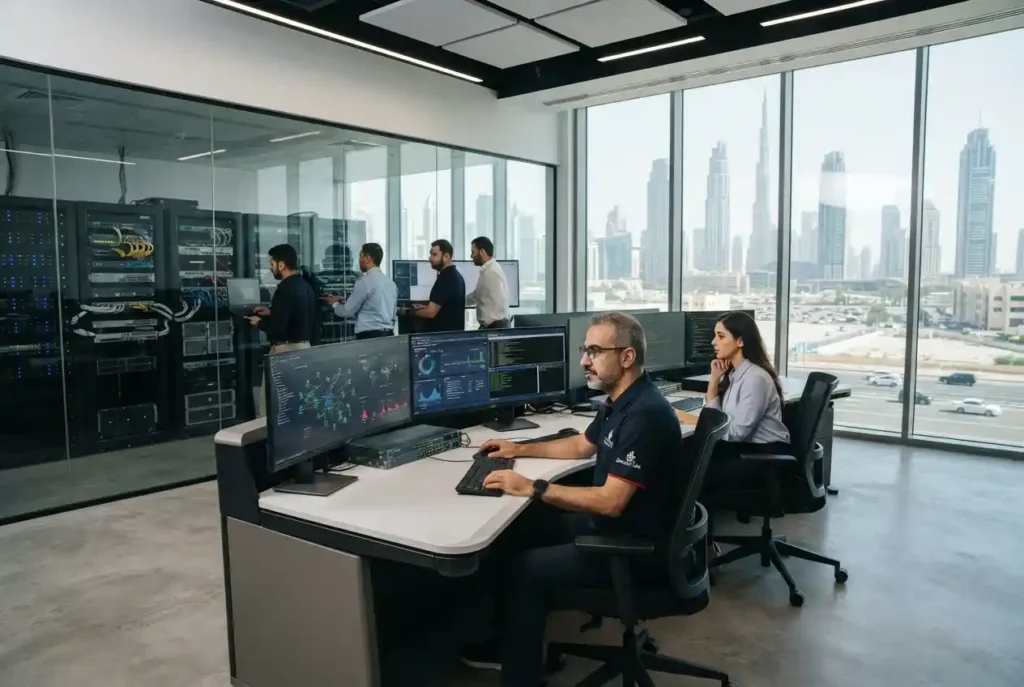
Emirates Link Technology is a UAE technology company operating in the information and communications technology sector. The company provides technology-related products and services for organizations that need reliable IT infrastructure, networking, security, communications, and digital business solutions.
As businesses across the UAE become increasingly dependent on connected systems, cloud platforms, cybersecurity, and digital workflows, technology providers play an important role in helping organizations build and maintain their IT environments. Emirates Link Technology operates within this wider ecosystem by serving business and institutional technology requirements.
For companies researching UAE technology providers, understanding the services, capabilities, and market role of Emirates Link Technology can help provide a broader view of the local IT sector.
What Is Emirates Link Technology?
Emirates Link Technology is an information technology and communications solutions provider based in the UAE. Its activities are associated with supplying and implementing technology products and solutions for business environments.
The company’s focus is connected to enterprise and commercial technology requirements rather than consumer-focused electronics. This can include infrastructure, networking, communications, security, hardware, software, and other technology services depending on the requirements of individual customers.
Organizations typically work with technology solution providers when they need assistance selecting, deploying, integrating, or supporting technology systems rather than simply purchasing individual products.
Emirates Link Technology LLC and the UAE Market
Emirates Link Technology LLC operates within the UAE’s competitive business technology environment. Dubai and Abu Dhabi have developed into major regional centers for companies in finance, logistics, real estate, healthcare, retail, hospitality, government, and professional services.
These industries depend on technology infrastructure for daily operations. Employees need connected workstations, businesses require secure networks, applications need reliable infrastructure, and organizations increasingly rely on cloud and digital services.
Local technology companies can help organizations address these requirements by combining product knowledge with implementation and support services.
Technology Solutions for UAE Businesses
Businesses rarely operate with a single technology system. A typical organization may use computers, servers, networking equipment, cloud services, cybersecurity platforms, business applications, communications tools, and data systems.
Integrating these components effectively is important because a problem in one part of the technology environment can affect other systems. For example, network problems can interrupt cloud applications, while inadequate security controls can create risks for business data.
Technology solution providers can therefore help businesses approach infrastructure as a connected environment rather than a collection of unrelated products.
IT Infrastructure and Networking
Reliable IT infrastructure provides the foundation for business operations. Depending on the organization, this may include servers, storage systems, network switches, wireless infrastructure, structured cabling, routers, firewalls, and other components.
Networking is especially important for organizations operating across multiple offices or locations. Employees need reliable access to applications and information, while IT teams need visibility and control over the network.
A technology provider can help organizations assess their network requirements, select appropriate equipment, configure systems, and maintain the infrastructure after deployment.
Business Communications Technology
Modern businesses depend on digital communication for collaboration with employees, customers, suppliers, and partners. Voice systems, video conferencing, messaging, email, and collaboration platforms have become important parts of the workplace environment.
Communications technology can also connect branch offices and remote employees. Organizations therefore need systems that provide reliable connectivity while maintaining appropriate security and access controls.
For UAE companies with distributed teams or multiple branches, communications infrastructure can become an important part of broader digital transformation plans.
Cybersecurity and Business Technology
Cybersecurity should be considered whenever organizations deploy connected technology. Businesses increasingly manage sensitive information through cloud applications, websites, internal systems, and employee devices.
Security can involve multiple layers, including firewalls, endpoint protection, identity management, access controls, network segmentation, data protection, monitoring, and employee awareness.
Technology providers can assist with implementing security products and infrastructure, but organizations should also maintain internal security policies and processes. No single security product can eliminate every cyber risk.
Cloud Technology and Digital Transformation
Cloud computing has changed the way businesses acquire and manage technology resources. Instead of relying entirely on physical infrastructure located at a company’s premises, organizations can use cloud platforms for applications, storage, computing, collaboration, backup, and other services.
Moving to the cloud can improve scalability and flexibility, but it also introduces new considerations around security, governance, connectivity, cost management, and data architecture.
UAE businesses evaluating cloud adoption should therefore develop a clear migration strategy. Some workloads may be appropriate for public cloud environments, while others may require private infrastructure or hybrid approaches.
Why Local Technology Support Matters
Technology problems can affect business productivity quickly. A network outage, failed server, security incident, or communications problem may prevent employees from accessing essential systems.
Local technology support can provide organizations with faster access to technical assistance and a better understanding of regional business requirements. This can be particularly valuable for companies that do not maintain large internal IT teams.
Businesses evaluating a technology provider should review support availability, response times, service agreements, escalation procedures, and the technical expertise available after deployment.
Emirates Link Technology and Business Connectivity
Connectivity is increasingly central to business operations. Employees access cloud applications, communicate through online platforms, exchange large files, and collaborate with colleagues across locations.
A reliable network architecture therefore needs to support both performance and security. Organizations may need wired and wireless networks, secure remote access, redundant connections, and appropriate monitoring.
Technology providers operating in the UAE can support businesses in designing connectivity environments that align with their size, location, workforce, and application requirements.
Technology Planning for Small and Medium Businesses
Small and medium-sized businesses often face different technology challenges from large enterprises. They may have limited internal IT resources while still needing secure and reliable infrastructure.
A practical technology strategy for an SME can include managed cloud applications, business-grade networking, endpoint security, backup, collaboration tools, and structured technical support.
Rather than investing in every available technology, smaller businesses should prioritize systems that directly support productivity, security, customer service, and business continuity.
Emirates Link Technology and Enterprise Technology
Larger organizations generally have more complex infrastructure requirements. They may operate multiple locations, large employee populations, specialized applications, data centers, and extensive security environments.
Enterprise technology projects can therefore require careful planning around architecture, integration, scalability, redundancy, security, and lifecycle management.
A technology partner can assist with different stages of such projects, from initial requirements analysis and product selection through implementation, testing, support, and maintenance.
How to Choose an IT Solutions Provider in the UAE
Businesses should evaluate technology providers based on the actual requirements of their organization. Important factors can include technical capabilities, relevant industry experience, product partnerships, implementation expertise, support services, response times, and total cost.
It is also useful to request a clear scope of work before beginning a technology project. The scope should identify the systems being installed or managed, responsibilities of each party, expected deliverables, timelines, warranties, support arrangements, and any recurring costs.
For complex projects, businesses should also consider how the proposed solution will scale as the organization grows.
Emirates Link Technology in the Wider UAE Technology Ecosystem
Emirates Link Technology operates alongside a broad range of technology businesses serving the UAE. These include global infrastructure companies, IT services providers, specialist systems integrators, cybersecurity companies, software businesses, and digital transformation firms.
Businesses researching this market can also explore Dell Technologies Dubai, DXC Technology Dubai, Cognizant Technology Solutions Dubai, and German Imaging Technologies.
These companies represent different areas of the technology ecosystem, from enterprise infrastructure and IT services to specialized workplace technology. Comparing providers according to the specific problem a business needs to solve can help organizations make more informed decisions.
Technology Trends Affecting UAE Businesses
UAE businesses are increasingly adopting artificial intelligence, cloud computing, automation, cybersecurity technologies, data analytics, and connected workplace systems. These trends are changing both the technology infrastructure companies require and the skills needed to manage it.
Artificial intelligence, for example, requires appropriate computing resources and reliable data environments. Cloud adoption requires stronger governance and security practices. Remote and hybrid work models require secure connectivity and device management.
Technology providers therefore increasingly need to understand how different systems work together rather than focusing on isolated products.
Building a Future-Ready IT Environment
A future-ready technology environment should be designed around flexibility and resilience. Businesses should consider how easily systems can scale, how quickly employees can be supported, and how effectively the organization can respond to changing technology requirements.
Regular infrastructure reviews can help identify outdated hardware, unsupported software, security gaps, connectivity problems, and inefficient systems before they become major operational issues.
Businesses should also maintain appropriate backup and disaster recovery arrangements. Technology resilience is not only about preventing failures but also about ensuring that the organization can recover effectively when unexpected incidents occur.
Final Insights
Emirates Link Technology represents the type of UAE technology provider that supports businesses with IT infrastructure, connectivity, communications, security, and related technology requirements.
For organizations operating in Dubai and elsewhere in the UAE, choosing the right technology partner requires more than comparing product prices. Businesses should consider implementation quality, compatibility, scalability, support, cybersecurity, and long-term operating costs.
As organizations continue moving toward cloud-based applications, connected workplaces, automation, and data-driven operations, reliable technology infrastructure will remain a fundamental part of business performance. Local technology providers can play an important role in helping UAE businesses build and maintain that foundation.